Maths Olympiad Prep

Library / NMO Selection Tests for the Junior Balkan Mathematical Olympiad /39 of 62

NMO Selection Tests for the Junior Balkan Mathematical Olympiad

Geometry Difficulty 6.1 National Olympiad Prove it Romania

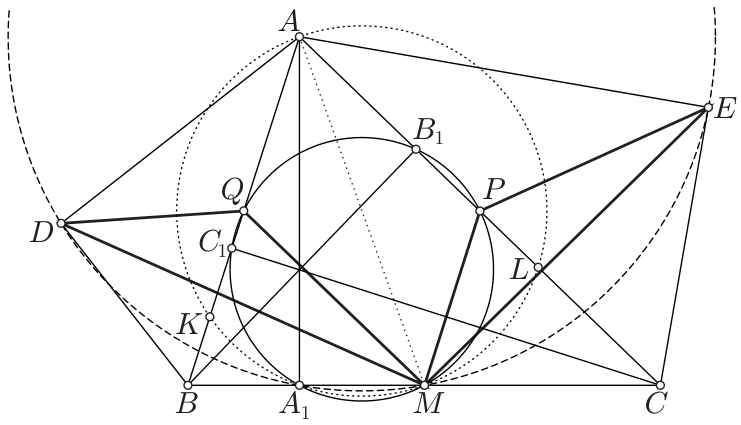
Given an acute triangle ABCABC, erect triangles ABDABD and ACEACE externally, so that ADB^=AEC^=90∘\widehat{ADB} = \widehat{AEC} = 90^\circ and BAD^≡CAE^\widehat{BAD} \equiv \widehat{CAE}. Let A1∈BCA_1 \in BC, B1∈ACB_1 \in AC and C1∈ABC_1 \in AB be the feet of the altitudes of the triangle ABCABC, and let KK and LL be the midpoints of [BC1][BC_1] and [CB1][CB_1], respectively. Prove that the circumcenters of the triangles AKLAKL, A1B1C1A_1B_1C_1 and DEA1DEA_1 are collinear.

Figure 1

Solution

Let MM, PP and QQ be the midpoints of [BC][BC], [CA][CA] and [AB][AB], respectively.

The circumcircle of triangle A1B1C1A_1B_1C_1 is the Euler circle. Point MM lies on this circle.

It is enough to prove now that [A1M][A_1M] is a common chord of the three circles, (A1B1C1)(A_1B_1C_1), (AKL)(AKL) and (DEA1)(DEA_1).

The segments [MK][MK] and [ML][ML] are midlines of the triangles BCC1BCC_1 and BCB1BCB_1 respectively, hence MK∥CC1⊥ABMK \parallel CC_1 \perp AB and ML∥BB1⊥ACML \parallel BB_1 \perp AC. So, the circle (AKL)(AKL) has diameter [AM][AM] and therefore passes through MM.

Finally, we prove that the quadrilateral DA1MEDA_1ME is cyclic.
From the cyclic quadrilaterals ADBA1ADBA_1 and AECA1AECA_1, AA1D‾≡ABD‾\overline{AA_1D} \equiv \overline{ABD} and AA1E‾≡ACE‾≡ABD‾\overline{AA_1E} \equiv \overline{ACE} \equiv \overline{ABD}, so DA1E‾=2ABD‾=180∘−2DAB‾\overline{DA_1E} = 2\overline{ABD} = 180^\circ - 2\overline{DAB}.
We notice now that DQ=AB/2=MPDQ = AB/2 = MP, QM=AC/2=PEQM = AC/2 = PE and
DQM‾=DQB‾+BQM‾=2DAB‾+BAC‾, \overline{DQM} = \overline{DQB} + \overline{BQM} = 2\overline{DAB} + \overline{BAC},
EPM‾=EPC‾+CPM‾=2EAC‾+CAB‾, \overline{EPM} = \overline{EPC} + \overline{CPM} = 2\overline{EAC} + \overline{CAB},
so ΔMPE≡ΔDQM\Delta MPE \equiv \Delta DQM (S.A.S.). This leads to DME‾=DMQ‾+QMP‾+PME‾=DMQ‾+BQM‾+QDM‾=180∘−DQB‾=180∘−2DAB‾\overline{DME} = \overline{DMQ} + \overline{QMP} + \overline{PME} = \overline{DMQ} + \overline{BQM} + \overline{QDM} = 180^\circ - \overline{DQB} = 180^\circ - 2\overline{DAB}.
Since m(DA1E‾)=m(DME‾)m(\overline{DA_1E}) = m(\overline{DME}), the quadrilateral DA1MEDA_1ME is cyclic.

Want a route through all this instead of an archive? The track puts 2,604 problems in a working order, from Junior Challenge level to the IMO shortlist.

Source: MathNet, licensed CC-BY-4.0. Statement reproduced verbatim; metadata (topic, difficulty) added by this project.