Let be a convex quadrangle and let and be variable points inside this quadrangle so that . Prove that the lines obtained in this way all pass through a fixed point, or they are all parallel.
Romania — NMO Selection Tests for the Balkan and International Mathematical Olympiads
Solution
By the condition in the statement, the points , , , and lie on some circle , and the points , , , and lie on some circle . The line is the radical axis of these two circles, and we proceed to prove that lies on this radical axis.
Let meet again at , and let meet again at ; if, say, is tangent to , then . Then , and
showing that the triangles and are similar and have opposite orientations. Hence , so .
---
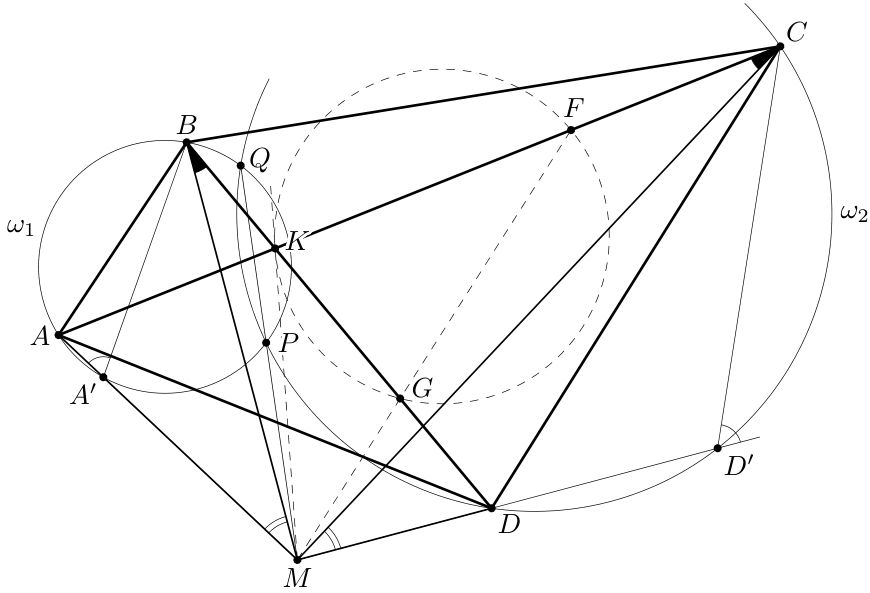
We still have to decide whether such a point exists, and deal with the exceptional cases. This can be done in several different ways, e.g., by investigating the orientation-changing similarity transformation mapping to and to . We present a more geometrical proof.
Let the diagonals and cross at . Choose points , on the diagonal , and , on the diagonal , so that the configurations and are similar.
If and are not parallel, then . By similarity, it is sufficient to find the point such that the triangles and are similar and have opposite orientations. If , one may choose to be the point where crosses the tangent at to the circle .
The exceptional cases are and (in which case by similarity). These cases may be considered as limit cases: in the former case, tends to and this can be dealt with along the above lines; in the latter, becomes an ideal point, so the lines are all parallel. In fact, both cases can be dealt with independently and are relatively easy.
Want a route through all this instead of an archive? The track
puts 2,604 problems in a working order, from Junior Challenge level to the IMO shortlist.