Determine all values of such that it is possible to divide a triangle in smaller triangles such that there are not three collinear vertices and such that each vertex belongs to the same number of segments.
Brazilian Mathematical Olympiad
Solution
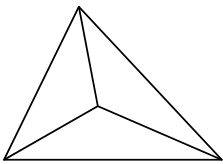
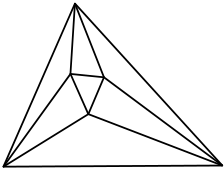
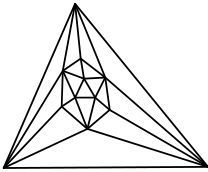
Consider the planar graph which vertices are the vertices of the triangles and edges are the sides of the triangles. Let , and be the number of vertices, edges and faces of such graph and be the degree of each vertex. Note that . Then and . By Euler's theorem, . It's not hard to see that and that each value for determines , and . Indeed ; ; . The following examples show that the possible values for are indeed , and .
Want a route through all this instead of an archive? The track
puts 2,604 problems in a working order, from Junior Challenge level to the IMO shortlist.