Maths Olympiad Prep

Library / /58 of 133

Geometry Difficulty 5.5 AIME, harder Prove it Saudi Arabia

Points MM and NN are considered in the interior of triangle ABCABC such that MAB^=NAC^\widehat{MAB} = \widehat{NAC} and MBA^=NBC^\widehat{MBA} = \widehat{NBC}. Prove that
AMANABAC+BMBNBABC+CMCNCACB=1. \frac{AM \cdot AN}{AB \cdot AC} + \frac{BM \cdot BN}{BA \cdot BC} + \frac{CM \cdot CN}{CA \cdot CB} = 1.

Solutions — 2

Solution 1

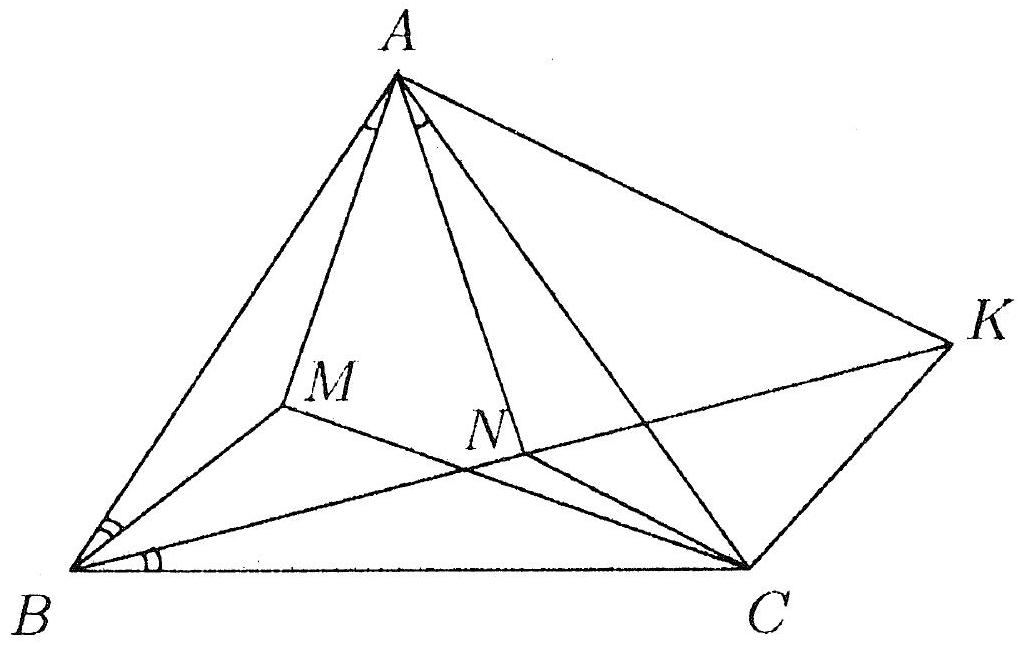
Figure 1

Let KK be a point on the ray BNBN such that BMA^=BCK^\widehat{BMA} = \widehat{BCK}. It is clear that KK is outside of triangle because BMA^>ACB^\widehat{BMA} > \widehat{ACB}. We have ABMKBC\triangle ABM \sim \triangle KBC, hence
ABBK=BMBC=AMCK.(1) \frac{AB}{BK} = \frac{BM}{BC} = \frac{AM}{CK} . \tag{1}
Now, we have ABKMBC\triangle ABK \sim \triangle MBC (since ABK^=MBC^\widehat{ABK} = \widehat{MBC} and ABBK=BMBC\frac{AB}{BK} = \frac{BM}{BC}), hence
ABBM=BKBC=AKCM.(2) \frac{AB}{BM} = \frac{BK}{BC} = \frac{AK}{CM} . \tag{2}
We obtained CKN^=MAB^=NAC^\widehat{CKN} = \widehat{MAB} = \widehat{NAC}. It follows that quadrilateral ANCKANCK is cyclic, and by using Ptolemy's theorem we get
AC(BKBN)=ANCK+CNAK.(3) AC \cdot (BK - BN) = AN \cdot CK + CN \cdot AK . \tag{3}
From (1) and (2) it follows
CK=AMBCBM,AK=ABCMBM,BK=ABBCBM. CK = \frac{AM \cdot BC}{BM}, \quad AK = \frac{AB \cdot CM}{BM}, \quad BK = \frac{AB \cdot BC}{BM} .
Replacing these relations in (3) we get
AC(ABBCBMBN)=AMANBCBM+CMCNABBM, AC \cdot \left( \frac{AB \cdot BC}{BM} - BN \right) = \frac{AM \cdot AN \cdot BC}{BM} + \frac{CM \cdot CN \cdot AB}{BM},
hence

AM\text{AM} AN}{AB \cdot AC} + BM\text{BM} BN}{BA \cdot BC} + CM\text{CM} CN}{CA \cdot CB} = 1 .

Solution 2

Using Ceva's theorem in trigonometric form for points MM and NN we get
sinMAB^sinMAC^sinMBC^sinMBA^sinMCA^sinMCB^=1, \frac{\sin \widehat{MAB}}{\sin \widehat{MAC}} \cdot \frac{\sin \widehat{MBC}}{\sin \widehat{MBA}} \cdot \frac{\sin \widehat{MCA}}{\sin \widehat{MCB}} = 1,
and
sinNAB^sinNAC^sinNBC^sinNBA^sinNCA^sinNCB^=1 \frac{\sin \widehat{NAB}}{\sin \widehat{NAC}} \cdot \frac{\sin \widehat{NBC}}{\sin \widehat{NBA}} \cdot \frac{\sin \widehat{NCA}}{\sin \widehat{NCB}} = 1
Multiplying these relations, it follows
sinMCA^sinMBC^sinNCA^sinNCB^=1, \frac{\sin \widehat{MCA}}{\sin \widehat{MBC}} \cdot \frac{\sin \widehat{NCA}}{\sin \widehat{NCB}} = 1,
hence
sinMCA^sinMCB^=sinNCB^sinNCA^.(2) \frac{\sin \widehat{MCA}}{\sin \widehat{MCB}} = \frac{\sin \widehat{NCB}}{\sin \widehat{NCA}} . \tag{2}
Denote MCB^=α\widehat{MCB} = \alpha and MCA^=β\widehat{MCA} = \beta and get
sin(Cα)sinα=sin(Cβ)sinβ.(3) \frac{\sin (C - \alpha)}{\sin \alpha} = \frac{\sin (C - \beta)}{\sin \beta} . \tag{3}
or
sinCcotαcosC=sinCcotβcosC \sin C \cdot \cot \alpha - \cos C = \sin C \cdot \cot \beta - \cos C
hence α=β\alpha = \beta.

Using complex coordinates, relation MCB^=ACN^\widehat{MCB} = \widehat{ACN} shows that
argmcbc=argacnc, \arg \frac{m-c}{b-c} = \arg \frac{a-c}{n-c},
hence the number mcbc:acnc\frac{m-c}{b-c} : \frac{a-c}{n-c} is real. We have
mcbcncac=mcbcncac=CMCNCBCA. \frac{m-c}{b-c} \cdot \frac{n-c}{a-c} = \left| \frac{m-c}{b-c} \cdot \frac{n-c}{a-c} \right| = \frac{CM \cdot CN}{CB \cdot CA} .
Finally, we get
AMANABAC=(ma)(na)(ba)(ca)=(ma)(na)(bc)(ab)(bc)(ca)=1 \sum \frac{AM \cdot AN}{AB \cdot AC} = \sum \frac{(m-a)(n-a)}{(b-a)(c-a)} \\ = \frac{\sum (m-a)(n-a)(b-c)}{(a-b)(b-c)(c-a)} = 1

Want a route through all this instead of an archive? The track puts 2,000 problems in a working order, from AMC 10 level to the IMO shortlist.

Source: MathNet, licensed CC-BY-4.0. Statement and solution reproduced as published; topic and difficulty added by this site.