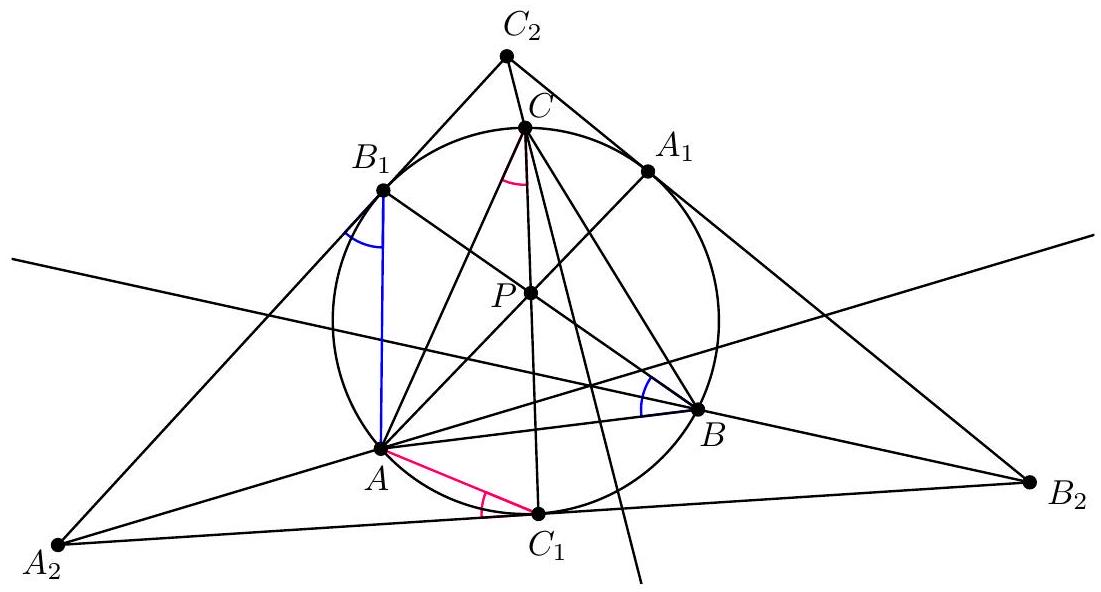
Triangle ABC is inscribed in circle ω. Point P lies inside triangle ABC. Lines AP, BP and CP intersect ω again at points A1, B1 and C1 (other than A, B, C), respectively. The tangent lines to ω at A1 and B1 intersect at C2. The tangent lines to ω at B1 and C1 intersect at A2. The tangent lines to ω at C1 and A1 intersect at B2. Prove that the lines AA2, BB2 and CC2 are concurrent.
Solution
Let R be the circumradius of triangle ABC. We have, using sine law, C1A=2Rsin∠ACP and AB1=2Rsin∠PBA. On the other hand, because lines A2C1 and A2B1 are tangent to ω, we have ∠AC1A2=∠ACP and ∠A2B1A=∠PBA. Applying sine law to triangles AA2C1 and AB1A2, we obtain AC1sin∠AA2C1=AA2sin∠AC1A2 and AB1sin∠AA2B1=AA2sin∠A2B1A. Therefore, we have sin∠AA2B1sin∠C1A2A=AB1⋅sin∠A2B1AAC1⋅sin∠AC1A2=sin2∠PBAsin2∠ACP We have, in a similar way sin∠BB2C1sin∠A1B2B=sin2∠PCBsin2∠BAP and sin∠CC2A1sin∠B1C2C=sin2∠PACsin2∠CBP But, because AP, BP and CP are concurrent, we have by trigonometric Ceva sin∠PACsin∠BAP⋅sin∠PBAsin∠CBP⋅sin∠PCBsin∠ACP=1. We deduce that sin∠AA2B1sin∠C1A2A⋅sin∠BB2C1sin∠A1B2B⋅sin∠CC2A1sin∠B1C2C=1. This proves, by using the reciprocal of trigonometric Ceva, that lines AA2, BB2 and CC2 are concurrent.
Want a route through all this instead of an archive? The track
puts 2,604 problems in a working order, from Junior Challenge level to the IMO shortlist.
Source: MathNet,
licensed CC-BY-4.0.
Statement reproduced verbatim; metadata (topic, difficulty) added by this project.