Maths Olympiad Prep

Library / /29 of 48

Geometry Difficulty 7.6 National olympiad, round 2 Prove it Asia Pacific Mathematics Olympiad (APMO)

Let a set SS of 2004 points in the plane be given, no three of which are collinear. Let L\mathcal{L} denote the set of all lines (extended indefinitely in both directions) determined by pairs of points from the set. Show that it is possible to colour the points of SS with at most two colours, such that for any points p,qp, q of SS, the number of lines in L\mathcal{L} which separate pp from qq is odd if and only if pp and qq have the same colour.

Note: A line \ell separates two points pp and qq if pp and qq lie on opposite sides of \ell with neither point on \ell.

Solution

Choose any point pp from SS and color it, say, blue. Let n(q,r)n(q, r) be the number of lines from L\mathcal{L} that separates qq and rr. Then color any other point qq blue if n(p,q)n(p, q) is odd and red if n(p,q)n(p, q) is even.

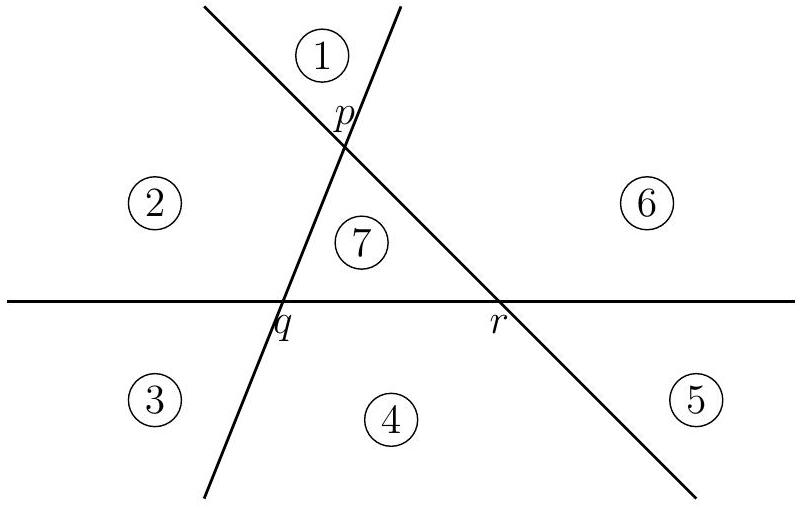
Now it remains to show that qq and rr have the same color if and only if n(q,r)n(q, r) is odd for all qpq \neq p and rpr \neq p, which is equivalent to proving that n(p,q)+n(p,r)+n(q,r)n(p, q)+n(p, r)+n(q, r) is always odd. For this purpose, consider the seven numbered regions defined by lines pq,prp q, p r, and qrq r :

Figure 1

Any line that do not pass through any of points p,q,rp, q, r meets the sides pq,qr,prp q, q r, p r of triangle pqrp q r in an even number of points (two sides or no sides), so these lines do not affect the parity of n(p,q)+n(p,r)+n(q,r)n(p, q)+n(p, r)+n(q, r). Hence the only lines that need to be considered are the ones that pass through one of vertices p,q,rp, q, r and cuts the opposite side in the triangle pqrp q r.

Let nin_{i} be the number of points in region ii, p,qp, q, and rr excluded, as depicted in the diagram. Then the lines through pp that separate qq and rr are the lines passing through pp and points from regions 1, 4, and 7. The same applies for p,qp, q and regions 2, 5, and 7; and p,rp, r and regions 3, 6, and 7. Therefore

n(p,q)+n(q,r)+n(p,r)(n2+n5+n7)+(n1+n4+n7)+(n3+n6+n7)n1+n2+n3+n4+n5+n6+n7=200431(mod2), \begin{aligned} n(p, q)+n(q, r)+n(p, r) & \equiv\left(n_{2}+n_{5}+n_{7}\right)+\left(n_{1}+n_{4}+n_{7}\right)+\left(n_{3}+n_{6}+n_{7}\right) \\ & \equiv n_{1}+n_{2}+n_{3}+n_{4}+n_{5}+n_{6}+n_{7}=2004-3 \equiv 1 \quad(\bmod 2), \end{aligned}

and the result follows.

Want a route through all this instead of an archive? The track puts 2,000 problems in a working order, from AMC 10 level to the IMO shortlist.

Source: MathNet, licensed CC-BY-4.0. Statement and solution reproduced as published; topic and difficulty added by this site.