Maths Olympiad Prep

Library / /52 of 61

Geometry Difficulty 7.2 National olympiad, round 2 Prove it Belarus

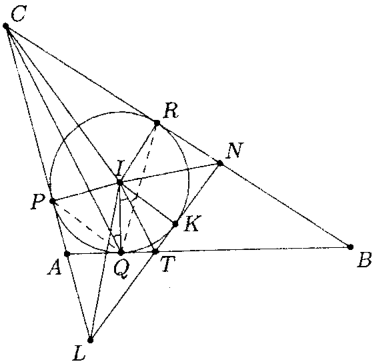
Let II be the incenter of the acute-angled non-isosceles triangle ABCABC. Let the incircle touch the side ABAB at point QQ. Point TT is marked on the side ABAB so that ITCQIT \parallel CQ. The line through TT touches the incircle at point KK (different from QQ) and meets the lines CACA and CBCB at points LL and NN, respectively.

Prove that TT is the midpoint of the segment LNLN.

(Ya. Konstantinovski)

Solution

Let x=CQIx = \angle CQI, y=QCIy = \angle QCI, 2α=BAC2\alpha = \angle BAC, 2β=ABC2\beta = \angle ABC, 2γ=ACB2\gamma = \angle ACB. Let rr be the inradius of the triangle ABCABC. It is easy to see that

Figure 1

CIQ=360902αγ= \angle CIQ = 360^\circ - 90^\circ - 2\alpha - \gamma =
=270(α+β+γ)α+β=180α+β. = 270^\circ - (\alpha + \beta + \gamma) - \alpha + \beta = 180^\circ - \alpha + \beta.
So,
x+y=180CIQ=αβ.(1) x + y = 180^\circ - \angle CIQ = \alpha - \beta. \quad (1)
Further,
QTL=NTB=1802(90x)=2x, \angle QTL = \angle NTB = 180^\circ - 2(90^\circ - x) = 2x,

hence
ILT=0.5ALT=0.5(2α2x)=αx,INT=0.5CNT==0.5(2β+2x)=β+x. \begin{aligned} \angle ILT &= 0.5\angle ALT = 0.5(2\alpha - 2x) = \alpha - x, \angle INT = 0.5\angle CNT = \\ &= 0.5(2\beta + 2x) = \beta + x. \end{aligned}
Then
LT=LKKT=rcotILTrtanx=r(cot(αx)tanx),NT=NK+KT=rcotINT+rtanx=r(cot(β+x)+tanx). \begin{aligned} LT &= LK - KT = r \cot \angle ILT - r \tan x = r(\cot(\alpha - x) - \tan x), \\ NT &= NK + KT = r \cot \angle INT + r \tan x = r(\cot(\beta + x) + \tan x). \end{aligned}
Therefore, from
cot(αx)tanx=cot(β+x)+tanx(2) \cot(\alpha - x) - \tan x = \cot(\beta + x) + \tan x \quad (2)
it will follow the problem condition.
Indeed, since
cot(αx)tanx=1+tanαtanxtanαtanxtanx==1+tanαtanxtanαtanx+tan2xtanαtanx=1+tan2xtanαtanx,cot(β+x)tanx=1tanβtanxtanβ+tanx+tanx==1tanβtanx+tanβtanx+tan2xtanβ+tanx=1+tan2xtanβ+tanx, \begin{aligned} \cot(\alpha - x) - \tan x &= \frac{1 + \tan \alpha \tan x}{\tan \alpha - \tan x} - \tan x = \\ &= \frac{1 + \tan \alpha \tan x - \tan \alpha \tan x + \tan^2 x}{\tan \alpha - \tan x} = \frac{1 + \tan^2 x}{\tan \alpha - \tan x}, \\ \cot(\beta + x) - \tan x &= \frac{1 - \tan \beta \tan x}{\tan \beta + \tan x} + \tan x = \\ &= \frac{1 - \tan \beta \tan x + \tan \beta \tan x + \tan^2 x}{\tan \beta + \tan x} = \frac{1 + \tan^2 x}{\tan \beta + \tan x}, \end{aligned}
we see that (2) is equivalent to
tanαtanx=tanβ+tanx.(3) \tan \alpha - \tan x = \tan \beta + \tan x. \quad (3)
By law of sines for CQT\triangle CQT, rsiny=CIsinx\frac{r}{\sin y} = \frac{CI}{\sin x}. Since CI=r/sinγCI = r/\sin \gamma, we have siny=sinγsinx\sin y = \sin \gamma \cdot \sin x, i.e. from (1) and the equality α+β+γ=90\alpha + \beta + \gamma = 90^\circ it follows that sin(αβx)=sinxcos(α+β)\sin(\alpha - \beta - x) = \sin x \cdot \cos(\alpha + \beta). Then
sinxcos(α+β)=sin(αβ)cosxcos(αβ)sinx,\sin x \cdot \cos(\alpha + \beta) = \sin(\alpha - \beta) \cos x - \cos(\alpha - \beta) \sin x,
so sinx(cos(α+β)+cos(αβ))=sin(αβ)cosx\sin x(\cos(\alpha + \beta) + \cos(\alpha - \beta)) = \sin(\alpha - \beta) \cos x, which is equivalent to
2sinxcosαcosβ=(sinαcosβcosαsinβ)cosx2 \sin x \cos \alpha \cos \beta = (\sin \alpha \cos \beta - \cos \alpha \sin \beta) \cos x,     2tanx=tanαtanβ\iff 2 \tan x = \tan \alpha - \tan \beta,
i.e. is equivalent to (3), as required.

Want a route through all this instead of an archive? The track puts 2,000 problems in a working order, from AMC 10 level to the IMO shortlist.

Source: MathNet, licensed CC-BY-4.0. Statement and solution reproduced as published; topic and difficulty added by this site.