Let be a circle in the plane and two points lying on it. We denote by the midpoint of and let be a new point on . Build circles and tangent to at and to at , respectively . Consider to be the point diametrically opposed to in . Prove that the circumcenter of lies on the line .
Flavian Georgescu
Local Mathematical Competitions
Solution
Let us begin by noticing that since is a diameter, we have , and if the circumcenter of would lie on , we could conclude that is tangent to the circumcircle of . Thus . Now since , , , are on , we have , so the problem is equivalent to .
Then we must prove that and are isogonal conjugates in the triangle , thus the quadrilateral is harmonic, which means .
This follows from the fact that since and are isogonal conjugates, we have
From the sine theorem we know
We also easily obtain
from the fact that is midpoint, and thus
LEMMA (Archimedes). Let be a circle, and two points on it, and a point on . Let be one of the two circles tangent to at , and to at . Then is the angle bisector of .
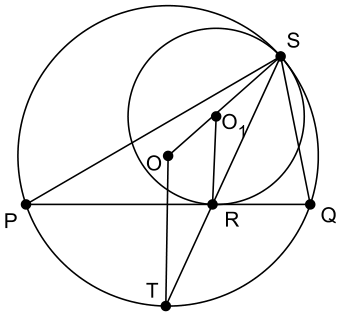
Proof. Let us denote by and the centers of the circles , respectively . Let . Let us note that the triangles and are isosceles triangles in and , and that . We conclude that . Since we deduce , so indeed is the midpoint of arc .
Using this LEMMA we get ( to be the angle bisector of and ( the angle bisector of ), so from the angle bisector theorem .
Want a route through all this instead of an archive? The track
puts 2,604 problems in a working order, from Junior Challenge level to the IMO shortlist.