Let be points on the line in that order and . Denote as some circle that passes through with its tangent lines at are . Denote as some circle that passes through with its tangent lines at are . Suppose that cuts at respectively; and cuts at respectively. Prove that four points belong to a same circle and the common external tangent lines of circles meet on .
Saudi Arabian IMO Booklet
Solution
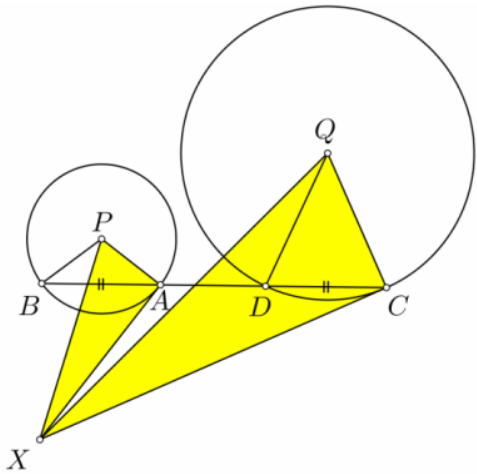
Consider the points that arranged as following figure, the other cases will be proved similarly.
Denote as intersection of the pairs of lines and . Note that and are cyclic quadrilateral. Thus
Hence, belong to the same circle.
Now, consider the following claim: Let be given two circles , and some line cuts them at such that (see the figure). The tangent lines at respectively of meet at then .
Indeed, by applying the sine law for triangle , we get
Thus two triangles and are similar, which implies that . The claim is proved.
Back to the problem, denote as the external and the internal homothety centers of then with is the ratio of radius of . It is easy to check that these radiuses are different, otherwise the the tangent lines of will be parallel and points will not exist, thus . In the other hand, by applying the above claim, we get
Hence, six points are all belong to the Apollonius circle with ratio constructing on the segment . Thus, the point , which also is the intersection of two common external tangent lines of , is on .
Want a route through all this instead of an archive? The track
puts 2,604 problems in a working order, from Junior Challenge level to the IMO shortlist.