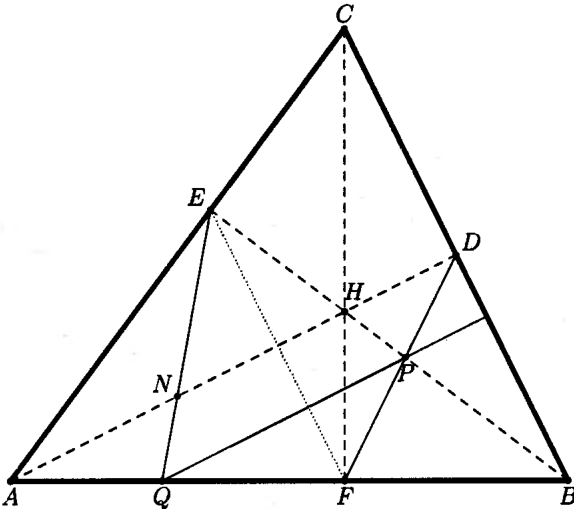
Let ABC be an acute triangle. Let H denote its orthocenter and D, E and F the feet of its altitudes from A, B and C, respectively. Let the common point of DF and the altitude through B be P. The line perpendicular to BC through P intersects AB in Q. Furthermore, EQ intersects the altitude through A in N. Prove that N is the mid-point of AH. (Karl Czakler)
Figure 3: Problem 13
Solution
See Figure 3. As usual, let β=∠ABC and γ=∠ACB. Since we know that
Figure 3: Problem 13
∠AFH=∠AEH=90∘ holds, the quadrilateral AFHE is cyclic, and because DA is parallel to PQ we obtain ∠FQP=∠FAH=∠FEH=∠FEP. It follows that QFPE is also cyclic. Since ∠AFC=∠ADC=90∘, AFDC is also cyclic, and we have ∠QFP=∠AFD=180∘−∠ACD=180∘−γ. We therefore have ∠QEP=γ. From this, we obtain ∠EAN=90∘−γ=∠AEP−∠QEP=∠AEN, which shows us that triangle ANE is isosceles. It therefore follows that N is the circumcenter of the right triangle AHE, and we therefore have NA=NH, as claimed.
Want a route through all this instead of an archive? The track
puts 2,604 problems in a working order, from Junior Challenge level to the IMO shortlist.
Source: MathNet,
licensed CC-BY-4.0.
Statement reproduced verbatim; metadata (topic, difficulty) added by this project.