A convex non-regular octagon is inscribed in a circle. Prove that .
IRL ABooklet
Solutions — 2
Solution 1
Connect to and to . This produces three cyclic quadrilaterals , , and .
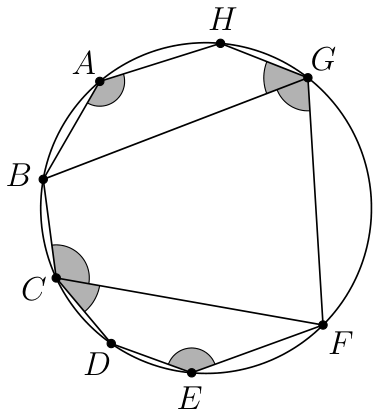
Because opposite angles in a cyclic quadrilateral add to , we see that which is half of the interior angle sum of an octagon. Therefore, .
Solution 2
Let be the centre of the circle and join to the vertices of the octagon. This way we obtain eight isosceles triangles.
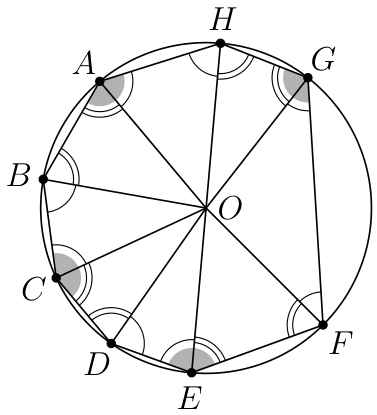
The connection from to a vertex splits the internal angles of the octagon at this vertex into two angles. For example, . These two angles are base angles of two different isosceles triangles. The other base angle of each of these isosceles triangles contributes to the internal angle of a neighbouring vertex. For example, contributes to and contributes to . Therefore, the sum of the interior angles at is the same as the sum of every second interior angle starting at , i.e. .
Want a route through all this instead of an archive? The track
puts 2,604 problems in a working order, from Junior Challenge level to the IMO shortlist.