Maths Olympiad Prep

Library / /20 of 40

Geometry Difficulty 6.0 National olympiad Prove it China

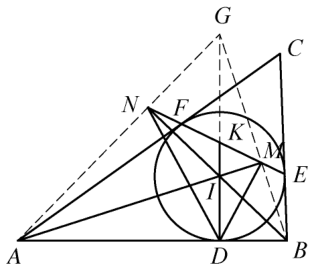
Let I\odot I be the incircle of ABC\triangle ABC. The circle I\odot I intersects sides ABAB, BCBC and CACA at points DD, EE and FF, respectively. Line EFEF intersects lines AIAI, BIBI and DIDI at points MM, NN and KK, respectively. Prove that DMKE=DNKFDM \cdot KE = DN \cdot KF. (posed by Zhang Pengcheng)

Solution

It is easy to see that points II, DD, EE and BB are concyclic and
AID=90IAD,MED=FDA=90IAD. \angle AID = 90^\circ - \angle IAD, \\ \angle MED = \angle FDA = 90^\circ - \angle IAD.
So AID=MED\angle AID = \angle MED, thus points II, DD, EE and MM are concyclic.
Hence, five points II, DD, BB, EE, MM are concyclic and IMB=IEB=90\angle IMB = \angle IEB = 90^\circ, that is AMBMAM \perp BM.
Similarly, points II, DD, AA, NN and FF are concyclic and BNANBN \perp AN.
Let lines ANAN and BMBM intersect at point GG. We see point II is the
Figure 1
Fig. 2. 1
orthocenter of GAB\triangle GAB and IDABID \perp AB, so points GG, II and DD are collinear.
Since points GG, NN, DD and BB are concyclic, we see that
ADN=G\angle ADN = \angle G.
Similarly, BDM=G\angle BDM = \angle G. So DKDK bisects MDN\angle MDN, thus
DMDN=KMKN.1 \frac{DM}{DN} = \frac{KM}{KN}. \qquad \textcircled{1}
Since points II, DD, EE and MM are concyclic, and points II, DD, NN and FF are concyclic, we see that
KMKE=KIKD=KFKN. KM \cdot KE = KI \cdot KD = KF \cdot KN.
Therefore,
KMKN=KFKE.2 \frac{KM}{KN} = \frac{KF}{KE}. \qquad \textcircled{2}
By ① and ②, we see that DMDN=KFKE\frac{DM}{DN} = \frac{KF}{KE}, that is DMKE=DNKFDM \cdot KE = DN \cdot KF. \square

Want a route through all this instead of an archive? The track puts 2,000 problems in a working order, from AMC 10 level to the IMO shortlist.

Source: MathNet, licensed CC-BY-4.0. Statement and solution reproduced as published; topic and difficulty added by this site.