A Geostationary Earth Orbit is situated directly above the equator and has a period equal to the Earth's rotational period. It is at the precise distance of 22,236 miles above the Earth that a satellite can maintain an orbit with a period of rotation around the Earth exactly equal to 24 hours. Because the satellites revolve at the same rotational speed of the Earth, they appear stationary from the Earth surface. That is why most station antennas (satellite dishes) do not need to move once they have been properly aimed at a target satellite in the sky. In an international project, a total of ten stations were equally spaced on this orbit (at the precise distance of 22,236 miles above the equator). Given that the radius of the Earth is 3960 miles, find the exact straight distance between two neighboring stations. Write your answer in the form a+bc, where a,b,c are integers and c>0 is square-free.
Solution
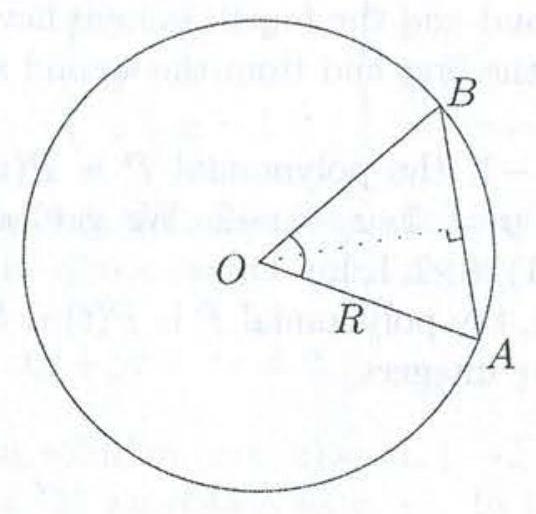
Let A and B be two neighboring stations. We have AOB=5π, hence AB=2Rsin10π, where R=22236+3960=26196. We will prove that sin10π=45−1.
Since sinπ=0, then sin(52π+53π)=0. We have: sin52πcos53π+cos52πsin53π=0⇒2sin5πcos5π(4cos35π−3cos5π)+(2cos25π−1)(3sin5π−4sin35π)=0 We may divide by sin5π and we get 2cos5π(4cos35π−3cos5π)+(2cos25π−1)(−1+4cos25π)=0 Denote y=cos5π. Then, our equation becomes 16y4−12y2+1=0 with the solutions given by y2=83±5. Since 6π<5π<4π, then cos5π∈(22,23), so that y2=83+5 and cos5π=83+5=45+1 Now, sin10π=21−cos5π=45−1. It follows AB=26196⋅25−1=−13098+130985
Want a route through all this instead of an archive? The track
puts 2,604 problems in a working order, from Junior Challenge level to the IMO shortlist.
Source: MathNet,
licensed CC-BY-4.0.
Statement reproduced verbatim; metadata (topic, difficulty) added by this project.