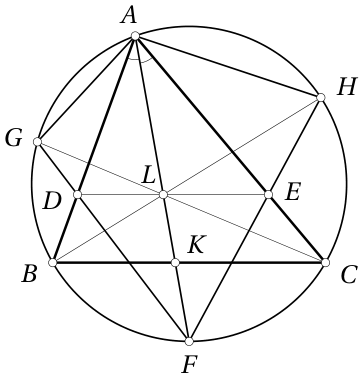
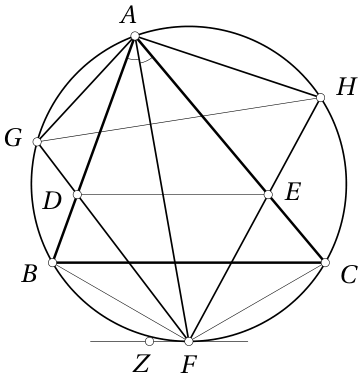
The bisector of the angle on vertex A of triangle ABC intersects the circumcircle of triangle ABC at point F (F=A). Points D and E are chosen on the sides AB and AC, respectively, in such a way that the lines DE and BC are parallel. Let G and H be the points of intersection of the rays FD and FE, respectively, with the circumcircle of triangle ABC (G=F,H=F). The circumcircles of triangles AGD and AHE intersect at point P (P=A). Prove that point P lies on the line AF.
Solutions — 2
Solution 1
Let K and L be the points of intersection of the line AF with lines BC and DE, respectively (Fig. 6). Then ∠AGD=∠AGF=∠AGC+∠CGF=∠ABC+∠CAF=∠ABK+∠KAB=∠CKA=∠KLD=180∘−∠ALD. Hence the quadrilateral AGDL is cyclic. Interchanging the roles of points B and C, points D and E and also points G and H, we can similarly prove that the quadrilateral AHEL is cyclic. Thus the circumcircles of triangles ADG and AEH meet at point L, i.e., P=L. Point L was chosen on the line AF.
Fig. 6
Solution 2
Choose a point Z on the same side of the line AF as point B such that ZF∥BC∥DE (Fig. 7). Then ∠ZFB=∠FBC=∠FAC=∠FAB=∠FCB. Hence ZF is tangent to the circumcircle of the triangle ABC at F, implying that ∠GFZ=∠GHF=∠GHE. As ∠GFZ=∠DFZ=∠FDE=180∘−∠GDE, we altogether have ∠GHE=180∘−∠GDE. Consequently, the quadrilateral DEHG is cyclic. Hence ∣FD∣⋅∣FG∣=∣FE∣⋅∣FH∣, implying that F lies on the radical axis of the circumcircles of triangles ADG and AEH. The desired result follows.
Fig. 7
Want a route through all this instead of an archive? The track
puts 2,604 problems in a working order, from Junior Challenge level to the IMO shortlist.
Source: MathNet,
licensed CC-BY-4.0.
Statement reproduced verbatim; metadata (topic, difficulty) added by this project.