Maths Olympiad Prep

Library / /17 of 22

Geometry Difficulty 7.1 National olympiad, round 2 Prove it South Africa

Let OO be the centre of a two-dimensional coordinate system, and let A1,A2,,AnA_1, A_2, \dots, A_n be points in the first quadrant and B1,B2,,BmB_1, B_2, \dots, B_m points in the second quadrant. We associate numbers a1,a2,,ana_1, a_2, \dots, a_n to the points A1,A2,,AnA_1, A_2, \dots, A_n and numbers b1,b2,,bmb_1, b_2, \dots, b_m to the points B1,B2,,BmB_1, B_2, \dots, B_m, respectively. It turns out that the area of triangle OAjBkOA_jB_k is always equal to the product ajbka_jb_k, for any jj and kk. Show that either all the AjA_j or all the BkB_k lie on a single line through OO.

Solutions — 2

Solution 1

Consider first the case that one of the areas is zero, e.g. area(OA1B1)=0\text{area}(OA_1B_1) = 0. Then either a1=0a_1 = 0 or b1=0b_1 = 0. If a1=0a_1 = 0, then area(OA1Bk)=a1bk=0\text{area}(OA_1B_k) = a_1b_k = 0 for all kk, which means that all BkB_k lie on a straight line through OO and A1A_1. Likewise, if b1=0b_1 = 0, then all AjA_j lie on a straight line through OO and B1B_1. So we can assume from now on that none of the areas is zero.

Suppose there are two points among A1,A2,,AnA_1, A_2, \dots, A_n that are not on the same line through OO (since the numbering does not matter, we can assume that A1A_1 and A2A_2 have this property), and at the same time there are two points (again, we can assume them to be B1B_1 and B2B_2) that are not on the same line through OO. We have
area(OA1B2)area(OA1B1)=a1b2a1b1=b2b1=a2b2a2b1=area(OA2B2)area(OA2B1). \frac{\text{area}(OA_1B_2)}{\text{area}(OA_1B_1)} = \frac{a_1b_2}{a_1b_1} = \frac{b_2}{b_1} = \frac{a_2b_2}{a_2b_1} = \frac{\text{area}(OA_2B_2)}{\text{area}(OA_2B_1)}.
Since triangles OA1B1OA_1B_1 and OA1B2OA_1B_2 have the same base (OA1OA_1), their heights must be in a b1/b2b_1/b_2-ratio. The same is true for the heights of triangles OA2B1OA_2B_1 and OA2B2OA_2B_2. If B1B2B_1B_2 is parallel to OA1OA_1, then b1=b2b_1 = b_2, so B1B2B_1B_2 is parallel to OA2OA_2. In this case, O,A1O, A_1 and A2A_2 lie on one line, contradicting the assumption. The same argument applies if B1B2B_1B_2 is parallel to OA2OA_2.

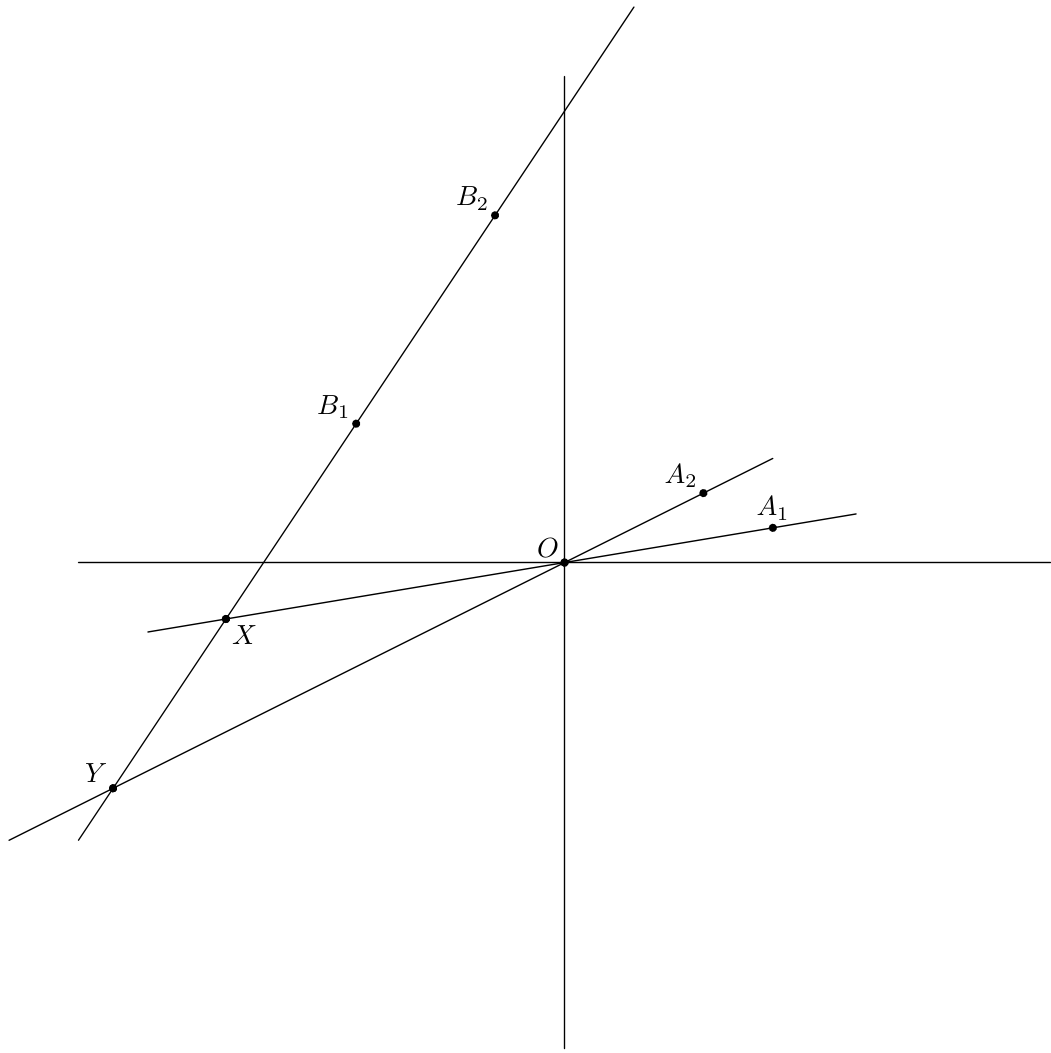
If neither OA1OA_1 nor OA2OA_2 is parallel to B1B2B_1B_2, let XX be the intersection of OA1OA_1 and B1B2B_1B_2, and let YY be the intersection of OA2OA_2 and B1B2B_1B_2.

Figure 1

Since A1A_1 and A2A_2 are in the first quadrant, XX and YY are either in the first or third quadrant. In either case, they are not between B1B_1 and B2B_2. Using similar triangles, we see that the ratio of the heights of OA1B1OA_1B_1 and OA1B2OA_1B_2 is XB1/XB2|XB_1|/|XB_2|, which must be b1/b2b_1/b_2. The same is true (analogously) for the ratio YB1/YB2|YB_1|/|YB_2|. Hence
XB1XB2=b1b2=YB1YB2 \frac{|XB_1|}{|XB_2|} = \frac{b_1}{b_2} = \frac{|YB_1|}{|YB_2|}
If XX and YY are on different sides of B1B2B_1B_2, one of these ratios is greater than 1, the other less than 1, a contradiction. Thus we assume that B1B_1 is closer to both XX and YY (otherwise, we just interchange the roles of B1B_1 and B2B_2), as in the figure. We get
1B1B2XB2=XB2B1B2XB2=YB2B1B2YB2=1B1B2YB2 1 - \frac{|B_1B_2|}{|XB_2|} = \frac{|XB_2| - |B_1B_2|}{|XB_2|} = \frac{|YB_2| - |B_1B_2|}{|YB_2|} = 1 - \frac{|B_1B_2|}{|YB_2|}
and thus XB2=YB2|XB_2| = |YB_2|. This means that XX and YY coincide, so X,Y,O,A1,A2X, Y, O, A_1, A_2 lie on one line, and we get a contradiction to our assumption again. This completes the proof.

Solution 2

We argue as in the first proof and assume again that A1A_1 and A2A_2 do not lie on a common line through OO, and that B1B_1 and B2B_2 do not lie on a common line through OO. Let α1,α2,β1,β2\alpha_1, \alpha_2, \beta_1, \beta_2 be the angles enclosed by OA1,OA2,OB1OA_1, OA_2, OB_1 and OB2OB_2 with the x-axis. Then
area(OA1B1)area(OA2B2)=a1b1a2b2=area(OA1B2)area(OA2B1) \text{area}(OA_1B_1) \cdot \text{area}(OA_2B_2) = a_1b_1a_2b_2 = \text{area}(OA_1B_2) \cdot \text{area}(OA_2B_1)
and thus
OA1OB1sin(β1α1)2OA2OB2sin(β2α2)2=OA1OB2sin(β2α1)2OA2OB1sin(β1α2)2 \frac{|OA_1||OB_1|\sin(\beta_1 - \alpha_1)}{2} \cdot \frac{|OA_2||OB_2|\sin(\beta_2 - \alpha_2)}{2} = \frac{|OA_1||OB_2|\sin(\beta_2 - \alpha_1)}{2} \cdot \frac{|OA_2||OB_1|\sin(\beta_1 - \alpha_2)}{2}
It follows that
sin(β1α1)sin(β2α2)=sin(β2α1)sin(β1α2). \sin(\beta_1 - \alpha_1) \sin(\beta_2 - \alpha_2) = \sin(\beta_2 - \alpha_1) \sin(\beta_1 - \alpha_2).
Now we use the trigonometric identity sinxsiny=12(cos(xy)cos(x+y))\sin x \sin y = \frac{1}{2}(\cos(x - y) - \cos(x + y)) to get
12(cos(β1α1+α2β2)cos(β1α1+β2α2))=12(cos(β2α1+α2β1)cos(β2α1+β1α2)). \frac{1}{2}(\cos(\beta_1 - \alpha_1 + \alpha_2 - \beta_2) - \cos(\beta_1 - \alpha_1 + \beta_2 - \alpha_2)) = \frac{1}{2}(\cos(\beta_2 - \alpha_1 + \alpha_2 - \beta_1) - \cos(\beta_2 - \alpha_1 + \beta_1 - \alpha_2)).
This implies
cos(β1α1+α2β2)=cos(β2α1+α2β1), \cos(\beta_1 - \alpha_1 + \alpha_2 - \beta_2) = \cos(\beta_2 - \alpha_1 + \alpha_2 - \beta_1),
and by the addition theorem for the cosine
cos(β1β2)cos(α1α2)+sin(β1β2)sin(α1α2)=cos(β1β2)cos(α1α2)sin(β1β2)sin(α1α2), \cos(\beta_1 - \beta_2) \cos(\alpha_1 - \alpha_2) + \sin(\beta_1 - \beta_2) \sin(\alpha_1 - \alpha_2) = \cos(\beta_1 - \beta_2) \cos(\alpha_1 - \alpha_2) - \sin(\beta_1 - \beta_2) \sin(\alpha_1 - \alpha_2),
so finally
sin(β1β2)sin(α1α2)=0, \sin(\beta_1 - \beta_2) \sin(\alpha_1 - \alpha_2) = 0,
which means that either β1=β2\beta_1 = \beta_2 or α1=α2\alpha_1 = \alpha_2, contradicting our assumption and thus completing the proof.

Want a route through all this instead of an archive? The track puts 2,000 problems in a working order, from AMC 10 level to the IMO shortlist.

Source: MathNet, licensed CC-BY-4.0. Statement and solution reproduced as published; topic and difficulty added by this site.