GeometryDifficulty 8.7ShortlistProve itUnited States
In a triangle ABC, let segment AP bisect ∠BAC, with P on side BC, and let segment BQ bisect ∠ABC, with Q on side CA. It is known that ∠BAC=60∘ and that AB+BP=AQ+QB. What are the possible angles of triangle ABC?
Solution
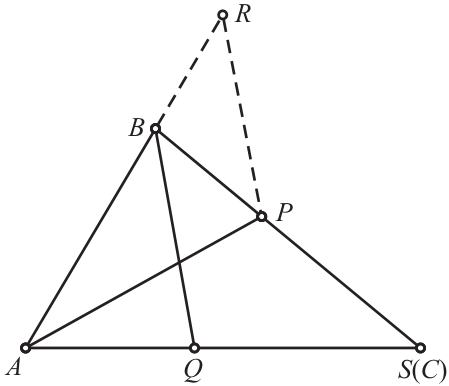
First Solution. (by Reid Barton and Gabriel Carroll) Extend segment AB through B to R so that BR=BP, and construct S on ray AQ so that AS=AR.
Lemma 1. Points B, P, S are collinear, and consequently, S coincides with C.
Proof. Because BR=BP, triangle BPR is isosceles with base angles ∠BRP=∠RPB=(180∘−∠PBR)/2=x=∠QBP.(2) Note that AS=AR and ∠RAS=∠BAC=60∘, implying that triangle ARS is equilateral. Since line AP bisects ∠RAS, R and S are symmetric with respect to line AP. Thus, PR=PS(3) and ∠ARP=∠PSA, or ∠BRP=∠PSQ. By (2), we have ∠QBP=∠BRP=∠PSQ.(4)
Because AQ+QS=AB+BR=AB+BP=AQ+QB, QS=QB. Hence, triangle BQS is isosceles with ∠BSQ=∠QBS.(5)
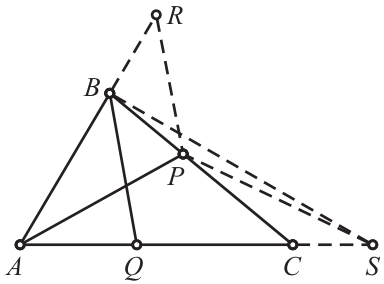
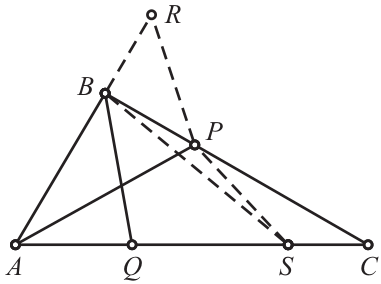
Now, assume to the contrary that triangle BPS is nondegenerate. Then either AC<AS, as in the first diagram below, or AC>AS, as in the second diagram.
In either diagram, combining (4) and (5) gives ∠PBS=∣∠QBP−∠QBS∣=∣∠PSQ−∠BSQ∣=∠PSB, that is, triangle PBS is isosceles with PB=PS. By (3), it follows that PB=PS=PR. Hence, triangle BPR is equilateral. But then ∠ABC=180∘−∠CBR=120∘, and by (1), y=0∘, which is absurd. Therefore, our assumption was wrong and B,P,S are collinear. Consequently, S=C. ■
---
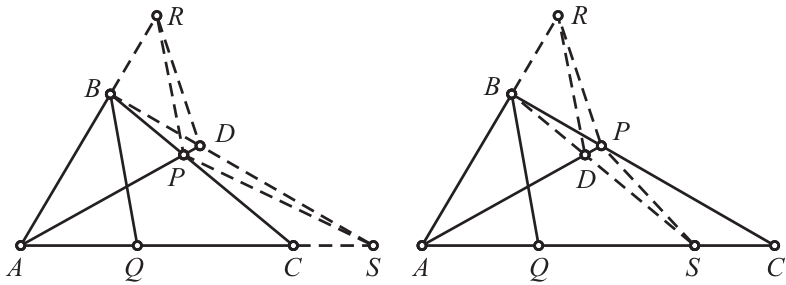
Second Solution. (By Zhiqiang Zhang, China) Construct R on ray AB beyond B such that BR=BP, and construct S on ray AQ beyond Q such that QS=QB. Let lines BS and AP intersect at D. Note that AR=AB+BP=AQ+QB=AS. Then both triangles BPR and BQS are isosceles with ∠BRP=∠RPB=2∠ABC=x=∠QBP(6) and ∠QBS=∠BSQ=2∠BQA=2180∘−60∘−x=60∘−2x.(7)
Because y>0∘, equation (1) implies x<60∘. Because AR=AS and ∠RAS=60∘, we also have that 60∘=∠ARS=∠BRS. Using these relations as well as (6), we find that ∠BRP=x<60∘=∠BRS, implying that P is inside triangle ARS. We now consider two cases.
i. C=S. Since BQ=QC, y=∠BCQ=∠QBC=x, so by (1), ∠ABC=80∘ and ∠BCA=40∘. We need to check whether such a triangle has the desired properties. Setting x=y, in isosceles triangle BPR we have ∠BRP=∠BPR=x. Hence, ∠ARP=∠BRP=x=y=∠PCA. This equality, along with the equations ∠PAR=∠CAP and AP=AP, implies that triangles APD and APC are congruent. Thus, AR=AC, or AB+BP=AQ+BQ. Therefore, ∠ABC=80∘, ∠BCA=40∘, and ∠CAB=60∘ are possible angles of triangle ABC.
ii. C=S.
Since AR=AS and AP is the angle bisector of angles RAS and BAC, R and S are symmetric with respect to line AP, and ∠BRD=∠DSQ. By (7), we have ∠BRD=∠DSQ=∠BSQ=∠QBS=∠QBD.(8) By subtraction, from (6) and (8) we obtain ∠PRD=∠BRD−∠BRP=∠QBD−∠QBP=∠PBD. Because P,D are on the same side of line BR (specifically, between rays AR and CS), quadrilateral BPDR must be cyclic. Hence, ∠BRD=∠BPA. Because angle BPA is an exterior angle of triangle APC, by using (1), we have ∠BPA=30∘+y=150∘−2x. On the other hand, by (8) and (7), ∠BRD=∠DSQ=∠BSQ= 60∘−2x. Now the relation ∠BRD=∠BPA reads 150∘−2x=60∘−2x, or x=60∘. But then y=0∘, which is impossible. Thus, there is no solution under the assumption C=S.
---
Third Solution. (By Liang Xiao, China) Construct R on ray AB beyond B such that BR=BP and S on ray AQ beyond Q such that QS=QB. Note that AR=AB+BP=AQ+QB=AS and hence, because ∠SAR=60∘, triangle ARS is equilateral. Now we calculate a few angles: ∠BPA∠BQA∠BSQ∠ABS∠RSB∠SBR=150∘−2x,=120∘−x,=∠QBS=2∠BQA=60∘−2x,=∠ABQ+∠QBS=60∘+2x,=60∘−∠BSQ=2x,=180∘−∠ABS=120∘−2x. Noting that BR=BP and AS=RS, we apply the Law of Sines to triangles BRS, ABP, and ABS to obtain sin∠SBRsin∠RSB=RSBR=ASBP=ABBP⋅ASAB=sin∠BPAsin∠PAB⋅sin∠ABSsin∠BSA. Writing these angles in terms of x, we have sin(120∘−2x)sin(2x)=sin(150∘−2x)sin30∘⋅sin(60∘+2x)sin(60∘−2x). Now, x=(120∘−y)/2<60∘ and hence sin(120∘−2x)=sin(60∘+2x)=0. Cancelling the common terms and clearing the denominators of the above equation, we obtain 2sin(2x)sin(30∘+2x)=cos(30∘+2x). Using the Product-to-sum formulas gives cos(30∘+23x)−cos(30∘+25x)=cos(30∘+2x), or cos(30∘+23x)=cos(30∘+25x)+cos(30∘+2x). Applying the Sum-to-product formulas yields cos(30∘+23x)=2cos(30∘+23x)cosx. Hence, either cosx=21 or cos(30∘+23x)=0. The first case is impossible because 0∘<x<60∘. In the second, 0∘<30∘+23x<120∘, implying that 30∘+23x=90∘ and x=40∘. Consequently, it is easy to check that ∠ABS=∠ABC=80∘ and S=C. Therefore, ∠ABC=80∘, ∠BCA=40∘, and ∠CAB=60∘.
---
Fourth Solution. (By Hui Zheng, China) Applying the Law of Sines to triangles ABP and ABQ yields ABAB+BP=1+sin(2x+30∘)sin30∘ and ABAQ+QB=sin(x+60∘)sinx+sin60∘. Thus, the condition AB+BP=AQ+BQ implies that 1+sin(2x+30∘)sin30∘=sin(x+60∘)sinx+sin60∘,(12) or 2sin(2x+30∘)sin(x+60∘)=sinx+sin60∘−sin(x+60∘). By (1), y>0∘ and 0∘<x<60∘. Applying the Difference-to-product formulas twice yields 2sin(2x+30∘)sin(x+60∘)=sin60∘−[sin(x+60∘)−sinx]=sin60∘−2sin30∘cos(x+30∘)=sin60∘−sin(60∘−x)=2sin2xcos(60−2x). By the Double-angle formulas, the numerator on the left-hand side is sin(x+60∘)=sin(120∘−x)=2sin(60∘−2x)cos(60∘−2x). Plugging in this expression and then dividing by cos(60∘−2x) — which is nonzero because 0∘<x<60∘ — we find that sin(2x+30∘)sin(60∘−2x)=2sin(2x). Clearing the denominator and applying the Product-to-sum formulas, the last equation becomes sin(60∘−2x)=2sin(2x)sin(2x+30∘)=2sin(2x)cos(2x−60∘)=sin(25x−60∘)+sin(60∘−23x), or sin(60−23x)=sin(60∘−2x)−sin(25x−60∘)=2sin(60∘−23x)cosx by applying the Difference-to-product formulas. Hence, sin(60∘−23x)=0orcosx=21. The only solution to either equation in the range 0∘<x<60∘ is x=40∘. Thus, ∠ABC=80∘, ∠BCA=40∘, and ∠CAB=60∘.
---
Fifth Solution. (By Kiran Kedlaya) We use complex numbers in this solution. Rewrite (12) as 1+2cos(2x−60∘)1−sin(x+60∘)sinx+sin60∘=0.(13) Set z=cosx+isinx and ω=e2πi/6=cos60∘+isin60∘. Because 0∘<x<60∘, we know that −1,1=zω. Now, zˉ=z1 and ωˉ=ω1. Also, ω3=−1andω−ω2=1.(14) It follows that 2isinx=z−zˉ=z−z1, 2isin60∘=ω−ω1, 2isin(x+60∘)=zω−zω1, and 2cos(2x−60∘)=ωz2+z2ω. We rewrite (13) in terms of z: 1+ωz2+z2ω1−zω−zω1z−z1+ω−ω1=0.(15) The second term on the left-hand side of (15) is z4+ω2z2ω and the third term simplifies to zω(zw)2−1(z+ω)−zωz+ω=(zω+1)(zω−1)(z+ω)(zω−1)=zω+1z+ω. Thus, (15) simplifies to 1+z4+ω2z2ω−zω+1z+ω=0. Clearing the denominators in this equations yields (z4+ω2)(zω+1)+z2ω(zω+1)−(z+ω)(z4+ω2)=0. If x≈60∘, then triangles ABQ and PBQ are approximately equilateral and AB+BP≈AQ+QB. Thus, we suspect that z=ω is a solution
---
of the above equation. With this in mind, we factor (14) as follows: 0=(z4+ω2)(zω+1)+z2ω(zω+1)−(z+ω)(z4+ω2)=z5ω+zω3+z4+ω2+z3ω2+z2ω−z5−zω2−z4ω−ω3=(ω−1)z5+(1−ω)z4+ω2z3+ωz2+(ω3−ω2)z+(ω2−ω3)=ω2z5−ω2z4+ω2z3+ωz2−ωz+ω=ω2z3(z2−z+1)+ω(z2−z+1)=ω2(z3−ω2)(z2−z+1). Hence, z3=ω2=cos120∘+isin120∘, so z=cos40∘+isin40∘, cos160∘+isin160∘, or cos280∘+isin280∘. yielding x=40∘,160∘, or 280∘. The only value in the range (0∘,60∘) is x=40∘, so ∠ABC=80∘, ∠BCA=40∘, and ∠CAB=60∘.
---
Sixth Solution. (By Belur Jana Venkatachala, India) Let a=BC, b=CA, c=AB, and 2s=a+b+c. By the Angle Bisector Theorem, we obtain BP=b+ccaandAQ=c+acb.(16) Lemma 2. We have BQ=c+a2cacas(s−b). Proof. Let [R] denote the area of region R. Then, 2acsinxcosx=acsin2x=2[ABC]=2[ABQ]+2[QBC]=c⋅BQsinx+a⋅BQsinx=BQ⋅(a+c)sinx, or BQ=a+c2accosx.(17) By the Law of Cosines, we obtain cos2x=cos∠ABC=2aca2+c2−b2. Applying the Double-angle formulas yields 2cos2x=cos2x+1=2aca2+c2−b2+1=2ac(a2+2ac+c2)−b2=2ac(a+c)2−b2=2ac(a+c+b)(a+c−b)=ac2s(s−b), or cosx=acs(s−b). Substituting this into (17) yields the desired result. (The result also follows directly from the Angle Bisector Theorem and the Stewart's Theorem.) ■
By lemma 2, the given condition reads c+b+cca=c+acb+c+a2cacas(s−b), or b+ca+b+c=a+cb+c+a2acas(s−b). Clearing the denominators yields (a+b+c)(c+a)c=b(b+c)c+2a(b+c)s(s−b).(18) Since (a+b+c)(c+a)−b(b+c)=(a+b+c)(c+a)−b(a+b+c)+ab=(a+b+c)(a+c−b)+ab=4s(s−b)+ab, (18) can be rewritten as 4cs(s−b)+abc=2a(b+c)s(s−b). Taking t=s(s−b), we obtain a quadratic in t: 4ct2−2a(b+c)t+abc=0, or (2t−ac)(2ct−ab)=0. Thus, t=2acort=2cab. If t=2ac, then s(s−b)=4ac, leading to 4(a+c+b)(a+c−b)=4(a+c)2−b2=4ac, or a2+ac+c2=b2. This equation and the Law of Cosines imply that ∠ABC=120∘, which is absurd.
If t=2cab, then s(s−b)=4cab2, leading to (a+c)2−b2=cab2. Hence, (a+c)2=c(a+c)b2, or bc=a+ccb⋅c1. By the second part of (16), the last equation is ACAB=ABAQ, which, along with ∠BAC=∠QAB, implies that triangles ABQ and ACB are similar. Hence, ∠ACB=∠ABQ=∠BQC, that is, ∠ABC=80∘, ∠BCA=40∘, and ∠CAB=60∘.
---
Therefore, ∠ABC=80∘, ∠BCA=40∘, and ∠CAB=60∘ is the only solution.
Want a route through all this instead of an archive? The track
puts 2,604 problems in a working order, from Junior Challenge level to the IMO shortlist.
Source: MathNet,
licensed CC-BY-4.0.
Statement reproduced verbatim; metadata (topic, difficulty) added by this project.