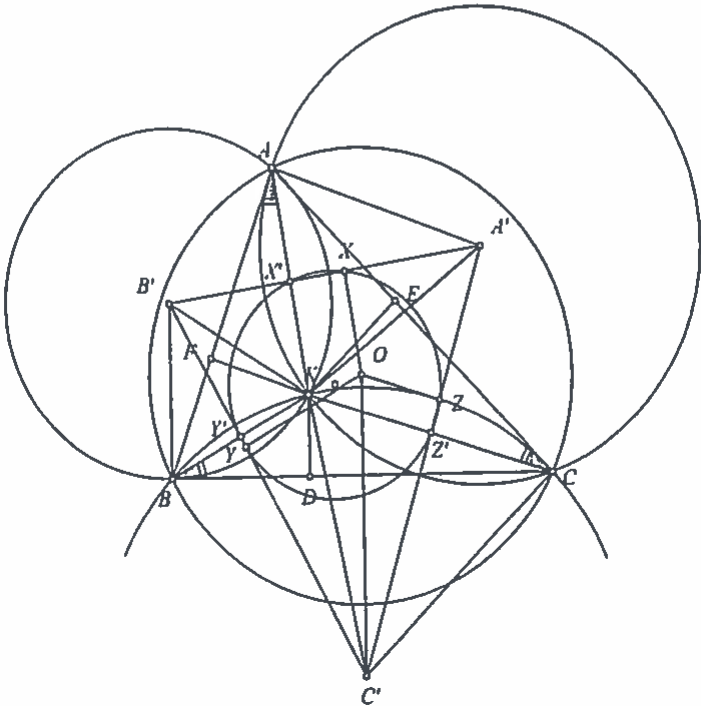
Let ABC be an acute triangle with circumcenter O. Let A′ be the center of the circle passing through C and tangent to AB at A, let B′ be the center of the circle passing through A and tangent to BC at B, let C′ be the center of the circle passing through B and tangent to CA at C.
a) Prove that the area of triangle A′B′C′ is not less than the area of triangle ABC.
b) Let X,Y,Z be the projections of O onto lines A′B′,B′C′,C′A′. Given that the circumcircle of triangle XYZ intersects lines A′B′,B′C′,C′A′ again at X′,Y′,Z′ (X′=X,Y′=Y,Z′=Z), prove that lines AX′,BY′,CZ′ are concurrent.
Solution
a) Let (A′),(B′),(C′) respectively represent the circle passing through point C and touching the line AB at point A, the circle passing through point B and touching the line BC at point B, and the circle passing through point C and touching the line CA at point C.
Let K be the second intersection point of two circles (A′) and (B′). We have (AK,AB)≡(BK,BC)≡(CK,CA)(modπ). Therefore, point K also belongs to circle (C′). Now, denote by D,E,F respectively the foot of the perpendicular drawn from point K to lines BC,CA and AB. According to Erdos inequality, we have KA+KB+KC≥2(KD+KE+KF).
Let ∠KBC=∠KAB=∠KCA=ω. Because sinω=KBKD=KCKE=KAKF=KB+KC+KAKD+KE+KF≤21 so ω≤30∘.
The triangles KAA′, KBB′, KCC′ are isosceles triangles at A′, B′, C′ with vertex angle equal to 2ω≤60∘.
Put (KA,KA′)≡(KB,KB′)≡(KC,KC′)≡ϕ(mod2π) and k=KAKA′=KBKB′=KCKC′≥1. We denote by f the rotational homothety with center K, angle ϕ and coefficient k.
Since A′, B′, C′ are images of A, B, C by f respectively, △A′B′C′∼△ABC. We deduce that S(ABC)S(A′B′C′)=k2≥1, or S(A′B′C′)≥S(ABC). The equality occurs if and only if ABC is an equilateral triangle.
b) Since A′, C′ are images of A, C through f and C′B′⊥BK, C′O⊥BC respectively, we get (C′K,C′A′)≡(CK,CA)≡(BK,BC)≡(C′B′,C′O)(modπ). Therefore C′O and C′K are isogonal in angle A′C′B′. By similar argument, we have O and K are isogonal conjugate points in triangle A′B′C′. So KX′⊥A′B′, KY′⊥B′C′ and KZ′⊥C′A′. We also have AK⊥A′B′, BK⊥B′C′ and CK⊥C′A′ so we deduce that three lines AX′, BY′ and CZ′ concur at K.
Want a route through all this instead of an archive? The track
puts 2,604 problems in a working order, from Junior Challenge level to the IMO shortlist.
Source: MathNet,
licensed CC-BY-4.0.
Statement reproduced verbatim; metadata (topic, difficulty) added by this project.