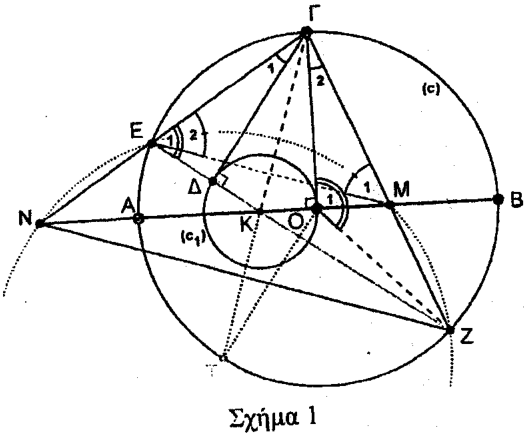
Let c(O,R) be a circle, AB a diameter and Γ the midpoint of the arch AB. We draw the circle cI(K,KO), where K is a point of the segment OA and we consider the tangents ΓΔ, ΓO from Γ to the circle cI(K,KO). The line KΔ intersects the circle c(O,R) at the points E and Z (the point E lies in the same semicircle with Γ). Finally, the lines EΓ and ΓZ intersect AB at the points N and M, respectively. Prove that the quadrilateral EMZN is an isosceles trapezium inscribed in a circle whose center lies on the circle c(O,R).
Solution
Let E^i=ΓE^Z. Then from the orthogonal triangle ΓΔE:Γ^1=90∘−E^1 (1) Since ΓO^Z=O^1 is the corresponding central angle of E^1=ΓE^Z, then O^1=2E^1 and from the isosceles triangle ΓOZ we have: Γ^2=2180∘−O^1=2180∘−2E^1=90∘−E^1.(2) From relations (1) and (2), we have: Γ^1=Γ^2. The triangles ΓΔE and ΓOM, are equal [ΓΔ^E=ΓO^M=90∘, Γ^1=Γ^2 and ΓΔ=ΓO]. Also the triangles ΓKΔ and ΓKO are equal and therefore we conclude that ΓEM is isosceles triangle and that ΓK is the bisector of the angle E^ΓM and perpendicular bisector of the segment EM. (A) From the equality of triangles ΓΔE and ΓOM, we conclude that: ΓE^Z=ΓM^O, and therefore NE^Z=NM^Z. Hence the quadrilateral EMZN is cyclic and we have the following equalities: M^1=E^NZ and E^2=M^ZN. Also, from the isosceles triangle ΓEM, we have: M^1=E^2. Therefore, we get that: E^NZ=M^ZN and then EMZN is isosceles trapezium.
The center of the circumcircle of EMZN is the point of intersection of two perpendicular bisectors of its sides. Let T is the point of intersection of ΓK (perpendicular bisector of EM) and the perpendicular bisector of EZ. In the triangle ΓEZ, ΓT is the bisector of the angle EΓ^Z and OT is the perpendicular bisector of the side EZ. Hence T belongs on the circumcircle of the triangle ΓEZ.
Want a route through all this instead of an archive? The track
puts 2,604 problems in a working order, from Junior Challenge level to the IMO shortlist.
Source: MathNet,
licensed CC-BY-4.0.
Statement reproduced verbatim; metadata (topic, difficulty) added by this project.