A circle of length is divided by marked points into arcs: arcs of length , arcs of length and arcs of length .
Prove that among the marked points there exist two which are endpoints of some diameter of the circle. (V. Prasolov, Problems in plane and solid geometry)
Croatian Mathematical Competitions
Solution
Let marked points be called outer points. We divide each of arcs of length into two arcs of equal length using one point, and each of arcs of length into three arcs of equal length using two points. Let those new points be called inner points. There are outer and inner points in total and they divide the circle into arcs of length . Since is odd, we conclude that diametrically opposite to each of those points there lies another of those points. From the definition of the inner points we see that there can not exist consecutive inner points.
Let us assume the opposite, i.e. that no two of outer points are diametrically opposite. That means that diametrically opposite to every outer point lies an inner point. Since there is an equal number of outer and inner points, we conclude that diametrically opposite to every inner point lies an outer point.
The points and are outer points so the points and are inner points. Due to the fact that there are no consecutive inner points, we conclude that the points and are outer. Hence, across the arc of length lies the arc of length . Since there is an equal number of arcs of lengths and , we get that across every arc of length lies an arc of length .
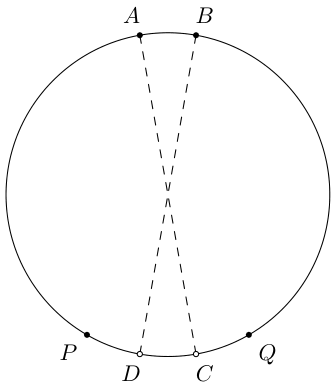
For , let be the number of arcs of length inside of the shorter arc and let be the number of arcs of length inside of the shorter arc . Length of the arc is so we have:
Since across every arc of length lies an arc of length and vice versa, we have:
There are exactly arcs of length so we have:
which using leads to:
Subtracting the equality from the inequality we get:
which is impossible, because the left-hand side of the equality is an even number, but the right-hand side is an odd number. Hence, we conclude that our assumption is wrong, so there exist two diametrically opposite outer points.
Want a route through all this instead of an archive? The track
puts 2,604 problems in a working order, from Junior Challenge level to the IMO shortlist.