In the interior of a cyclic quadrangle a point is given such that
Denote by , , and the feet of the perpendiculars from the point to the lines , and , respectively. Show that the triangles and are similar.
Czech-Slovak-Polish Match
Solution
Let be the circumcircle of the quadrangle and , the circumcircles of the triangles and , respectively. In the interior of the angle , consider the half-line such that . Then the hypothesis on implies that (Fig. 1)
Thus is the common interior tangent of the circles and .
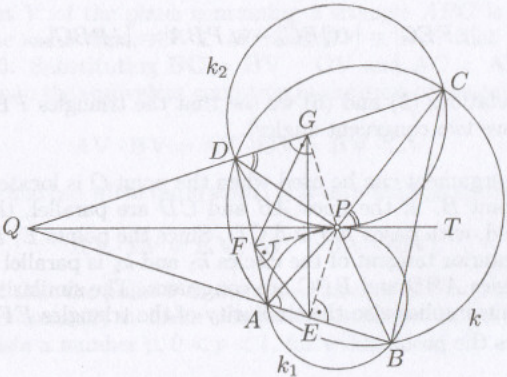
Fig. 1
Let us first assume that the sides and of the given cyclic quadrangle are not parallel. Since the segments and are common chords of the circles , and , , respectively, there exists a unique point having the same power with respect to all three circles , and . The point is the intersection of the three lines , and . Without loss of generality, we can assume that the point is located on the half-line beyond the point (Fig. 1). Then we have
Since , the quadrangle is cyclic, and
Similarly we see that the quadrangle is cyclic. It follows that
Since further , the quadrangle is also cyclic and
From the relations (2), (4) and the equality , we further have
Since the quadrangle is cyclic, . From the relations (1) and (5) we thus get
Using finally the relations (3) and (6) we see that the triangles and are similar (as they have two congruent angles).
An analogous argument can be used when the point is located on the half-line beyond the point . If the lines and are parallel, then is an equilateral trapezoid, with bases and . Since the points , , are collinear and the common interior tangent of the circles and is parallel to both lines and , the triangles and are congruent. The similarity of the triangles and thus implies also the similarity of the triangles and .
This completes the proof.
Want a route through all this instead of an archive? The track
puts 2,604 problems in a working order, from Junior Challenge level to the IMO shortlist.