Let be a regular hexagon with sidelength . The points and are on the diagonals and , respectively, such that .
Prove that the three points , and are on a line.
AUT ABooklet
Solution
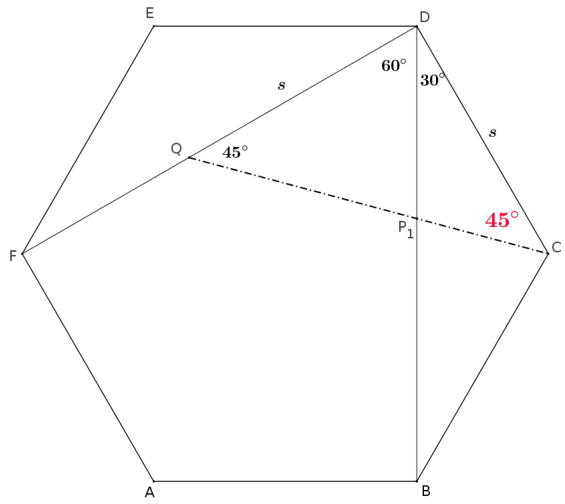
Figure 1: Problem 2
Solution:
Our strategy is to compute the angles and to check that they are equal.
The interior angles of a regular hexagon equal . The triangle is isosceles and therefore, we get . This implies , and since the triangle is also isosceles, we also get
The triangle is isosceles and analogously to the above, we get . Therefore, we obtain
So which implies that , and lie on a line.
(Walther Janous)
Want a route through all this instead of an archive? The track
puts 2,604 problems in a working order, from Junior Challenge level to the IMO shortlist.