Maths Olympiad Prep

Library / Selected Problems from Open Contests /9 of 12

Selected Problems from Open Contests

Geometry Difficulty 5.5 AIME, harder Prove it Estonia

Let ABCABC be a triangle with integral side lengths. The angle bisector drawn from BB and the altitude drawn from CC meet at point PP inside the triangle. Prove that the ratio of areas of triangles APBAPB and APCAPC is a rational number.

Solutions — 2

Solution 1

Let HH be the foot of the altitude drawn from CC. First prove that ∣AH∣|AH| and ∣BH∣|BH| are rational numbers. For that, use the Pythagorean theorem for triangles ACHACH and BCHBCH to obtain ∣AH∣2+∣CH∣2=∣AC∣2|AH|^2 + |CH|^2 = |AC|^2 and ∣BH∣2+∣CH∣2=∣BC∣2|BH|^2 + |CH|^2 = |BC|^2. Therefore ∣AC∣2−∣BC∣2=∣AH∣2−∣BH∣2=(∣AH∣−∣BH∣)⋅(∣AH∣+∣BH∣)=(∣AH∣−∣BH∣)⋅∣AB∣|AC|^2 - |BC|^2 = |AH|^2 - |BH|^2 = (|AH| - |BH|) \cdot (|AH| + |BH|) = (|AH| - |BH|) \cdot |AB|. We see that ∣AH∣−∣BH∣=∣AC∣2−∣BC∣2∣AB∣|AH| - |BH| = \frac{|AC|^2 - |BC|^2}{|AB|} is rational and so are ∣AH∣=∣AC∣2+∣BC∣2∣AB∣|AH| = \frac{|AC|^2 + |BC|^2}{|AB|}
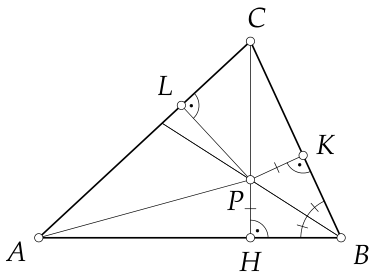
Figure 1
Fig. 6
and ∣BH∣=∣AH∣−(∣AH∣−∣BH∣)|BH| = |AH| - (|AH| - |BH|). Let now KK be the projection of PP to BCBC (see Fig. 6). As PP lies on the angle bisector of BB, it is equidistant from both ABAB and BCBC, i.e., ∣PH∣=∣PK∣|PH| = |PK|. Consequently,

SAPBSBPC=∣AB∣⋅∣PH∣∣BC∣⋅∣PK∣=∣AB∣∣BC∣⋅∣BH∣∣AH∣As CH⊥AB, also SBPCSAPC=∣CP∣⋅∣BH∣∣CP∣⋅∣AH∣=∣BH∣∣AH∣ \frac{S_{APB}}{S_{BPC}} = \frac{|AB| \cdot |PH|}{|BC| \cdot |PK|} = \frac{|AB|}{|BC|} \cdot \frac{|BH|}{|AH|} \quad \text{As } CH \perp AB, \text{ also } \frac{S_{BPC}}{S_{APC}} = \frac{|CP| \cdot |BH|}{|CP| \cdot |AH|} = \frac{|BH|}{|AH|}
Thus, SAPBSAPC=∣AB∣∣BC∣⋅∣BH∣∣AH∣\frac{S_{APB}}{S_{APC}} = \frac{|AB|}{|BC|} \cdot \frac{|BH|}{|AH|} is rational as a product of two rational numbers.

Solution 2

Let HH be the foot of the altitude drawn from CC and let LL be the projection of PP to ACAC (see Fig. 6). Now ∠CPL=90∘−∠ACH=90∘−(90∘−∠CAB)=∠CAB\angle CPL = 90^\circ - \angle ACH = 90^\circ - (90^\circ - \angle CAB) = \angle CAB, giving ∣PH∣∣PL∣=∣PH∣∣PC∣⋅cos⁡∠CAB\frac{|PH|}{|PL|} = \frac{|PH|}{|PC| \cdot \cos \angle CAB}. The angle bisector theorem gives ∣PH∣∣PC∣=∣BH∣∣BC∣=cos⁡∠ABC\frac{|PH|}{|PC|} = \frac{|BH|}{|BC|} = \cos \angle ABC. Consequently,
SAPBSAPC=∣AB∣⋅∣PH∣∣AC∣⋅∣PL∣=∣AB∣∣AC∣⋅cos⁡∠ABCcos⁡∠CAB \frac{S_{APB}}{S_{APC}} = \frac{|AB| \cdot |PH|}{|AC| \cdot |PL|} = \frac{|AB|}{|AC|} \cdot \frac{\cos \angle ABC}{\cos \angle CAB}
As the side lengths of the triangle ABCABC are integers, ∣AB∣∣AC∣\frac{|AB|}{|AC|} is rational. By the cosine law, the cosines of the angles of triangle ABCABC are rational, whence cos⁡∠ABCcos⁡∠CAB\frac{\cos \angle ABC}{\cos \angle CAB} is rational. Altogether, SAPBSAPC\frac{S_{APB}}{S_{APC}} is rational.

Want a route through all this instead of an archive? The track puts 2,604 problems in a working order, from Junior Challenge level to the IMO shortlist.

Source: MathNet, licensed CC-BY-4.0. Statement reproduced verbatim; metadata (topic, difficulty) added by this project.