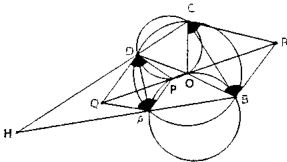
The circumcenter of the cyclic quadrilateral ABCD is O. The second intersection point of the circles ABO and CDO, other than O, is P, which lies in the interior of the triangle DAO. Choose a point Q on the extension of OP beyond P, and a point R on the extension of OP beyond O. Prove that ∠QAP=∠OBR holds if and only if ∠PDQ=∠RCO.
Solution
Let H be the radical center of the circles ABCD, ABOP and CDPO. Then the radical axes of any two of these circles, i.e. the lines AB, CD and OP, pass through H. Since P lies on the shorter arcs AO and DO, it follows that H lies on the extension of OP beyond P. The radical center satisfies HA⋅HB=HC⋅HD=HO⋅HP. (1) Since the quadrilateral ABOP is cyclic, ∠QAB+∠BRQ=(∠PAB+∠QAP)+(∠BOP−∠OBR)=(∠PAB+∠BOP)+(∠QAP−∠OBR)=180∘+(∠QAP−∠OBR). Therefore, ∠QAP=∠OBR holds if and only if the quadrilateral ABRQ is cyclic, which is equivalent to HQ⋅HR=HA⋅HB. Similarly, ∠QAP=∠OBR holds if and only if HQ⋅HR=HC⋅HD. Combining with (1), ∠QAP=∠OBR⇔HQ⋅HR=HA⋅HB⇔HQ⋅HR=HC⋅HD⇔∠PDQ=∠RCO.
Want a route through all this instead of an archive? The track
puts 2,000 problems in a working order, from AMC 10 level to the IMO shortlist.
Source: MathNet,
licensed CC-BY-4.0.
Statement and solution reproduced as published; topic and difficulty added by this site.