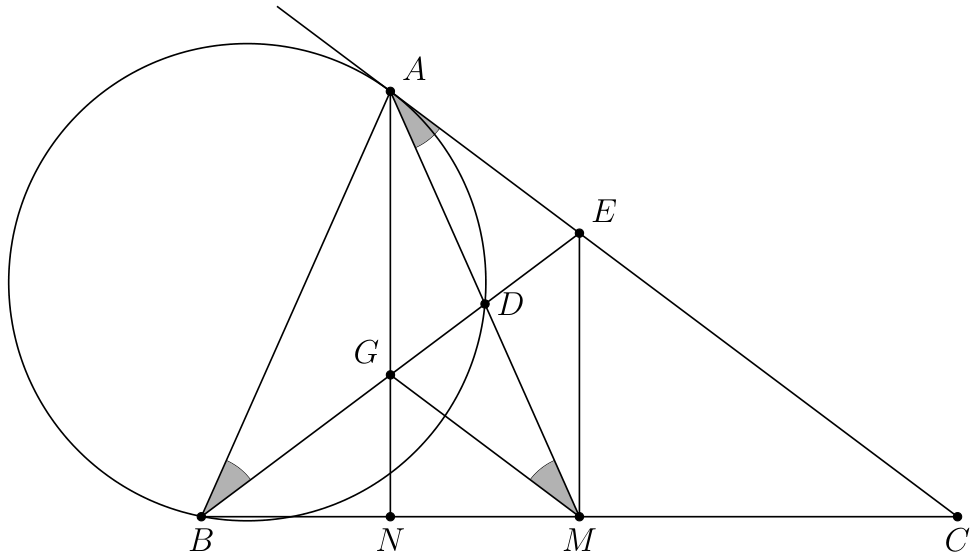
Because AN is the perpendicular bisector of BM, triangle ABM is isosceles with ∠ABM=∠AMB. Similarly, ∠ECB=∠EBC in the isosceles triangle EBC. We have ∠AMB=∠MAC+∠ECB (external angle) and ∠ABM=∠ABE+∠EBC.
Combining these equalities, we obtain
∠ABE+∠EBC=∠MAC+∠ECB=∠MAC+∠EBC,
hence ∠ABE=∠MAC which means that AC is tangent to the circumcircle of △ADB. This proves (a).
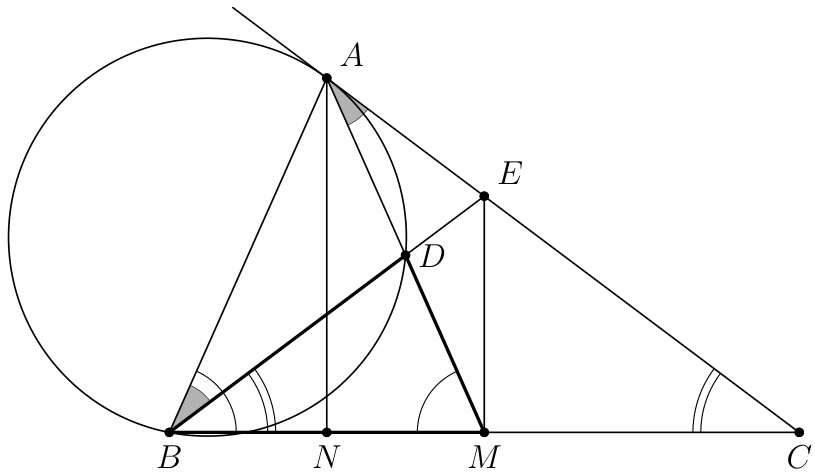
To prove (b) we note that △ACB∼△DBM since ∠ABM=∠AMB and ∠ECB=∠EBC. Consequently,
∣AM∣∣DM∣=∣AB∣∣DM∣=∣CB∣∣BM∣=21
which means that D is the midpoint of AM.