Let be a cyclic quadrilateral with , let be the circle centered at tangent to , and let be the incenter of . Show that the line through parallel to is tangent to .
Cesko-Slovacko-Poljsko, 2013
Solutions — 2
Solution 1
Let be the line tangent at to the circumcircle of . Since is the midpoint of the arc , we have , and we see that is tangent to . Similarly, if is the midpoint of the arc of , then is tangent to the circle centered at tangent to . Thus the line symmetric to with respect to is tangent to and (Fig. 2). However, the well-known relations and imply that and are symmetric with respect to . Hence lies on and it remains to show that . This follows from
(all angles here are directed).
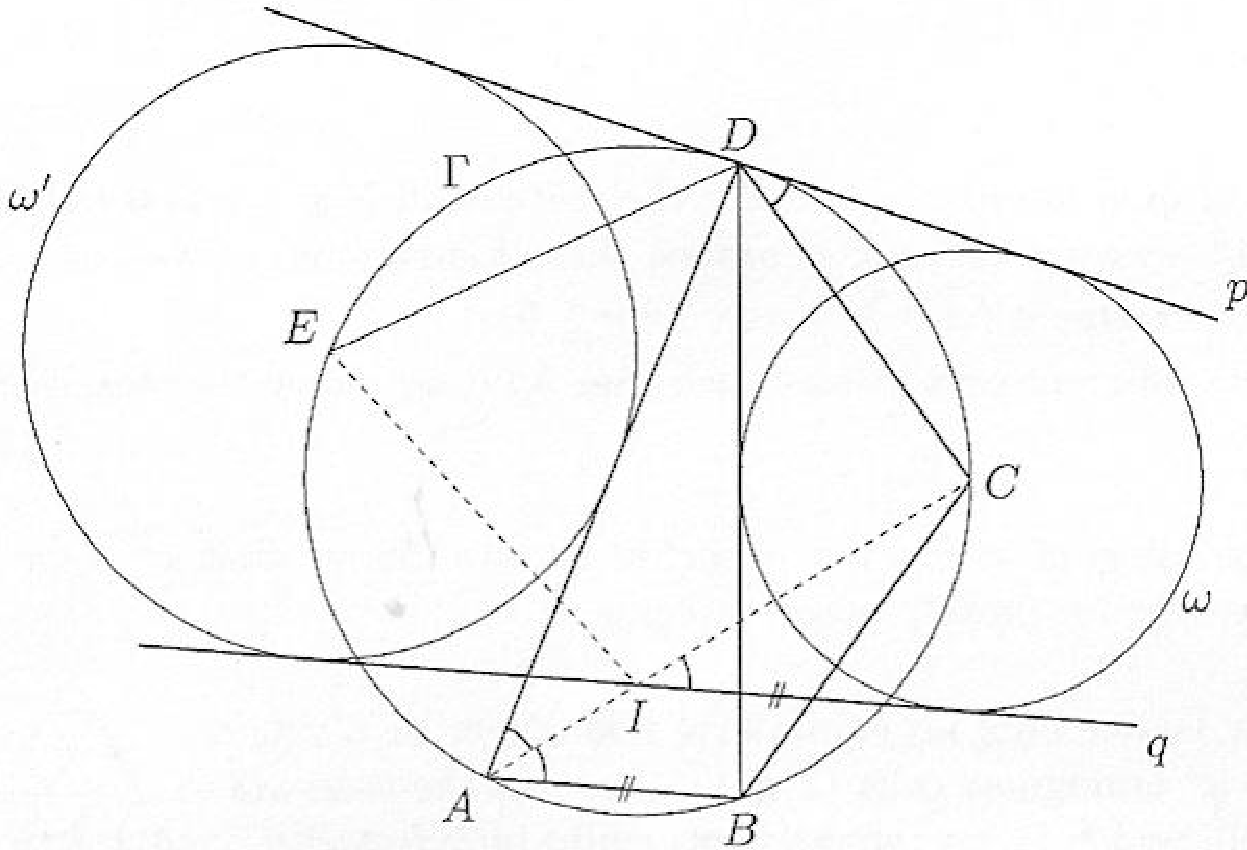
Fig. 2
Solution 2
Let denote the line through parallel to . is the orthogonal projection of on , is the midpoint of (Fig. 3). We have
Applying the well-known relation , we conclude right triangles and are congruent, so . The conclusion follows.
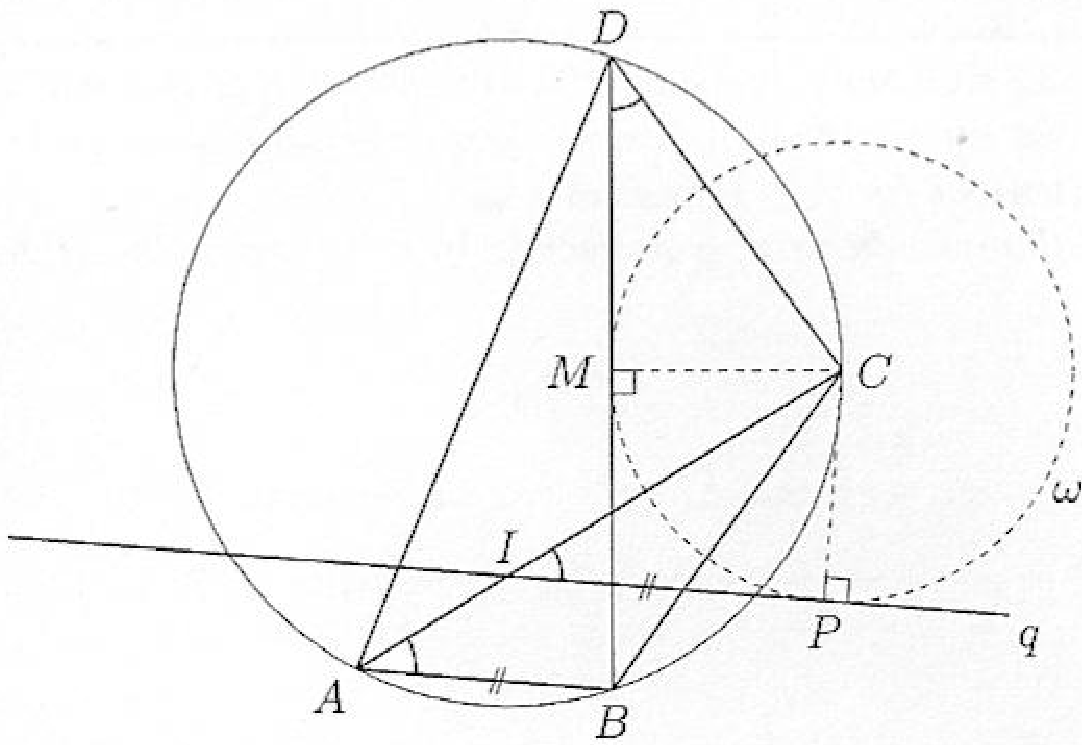
Fig. 3
Want a route through all this instead of an archive? The track
puts 2,604 problems in a working order, from Junior Challenge level to the IMO shortlist.