Maths Olympiad Prep

Library / /7 of 16

Geometry Difficulty 8.4 Shortlist Prove it IMO

Let ABCDABCD be a circumscribed quadrilateral. Let gg be a line through AA which meets the segment BCBC in MM and the line CDCD in NN. Denote by I1,I2I_{1}, I_{2}, and I3I_{3} the incenters of ABM\triangle ABM, MNC\triangle MNC, and NDA\triangle NDA, respectively. Show that the orthocenter of I1I2I3\triangle I_{1} I_{2} I_{3} lies on gg.

Solutions — 2

Solution 1

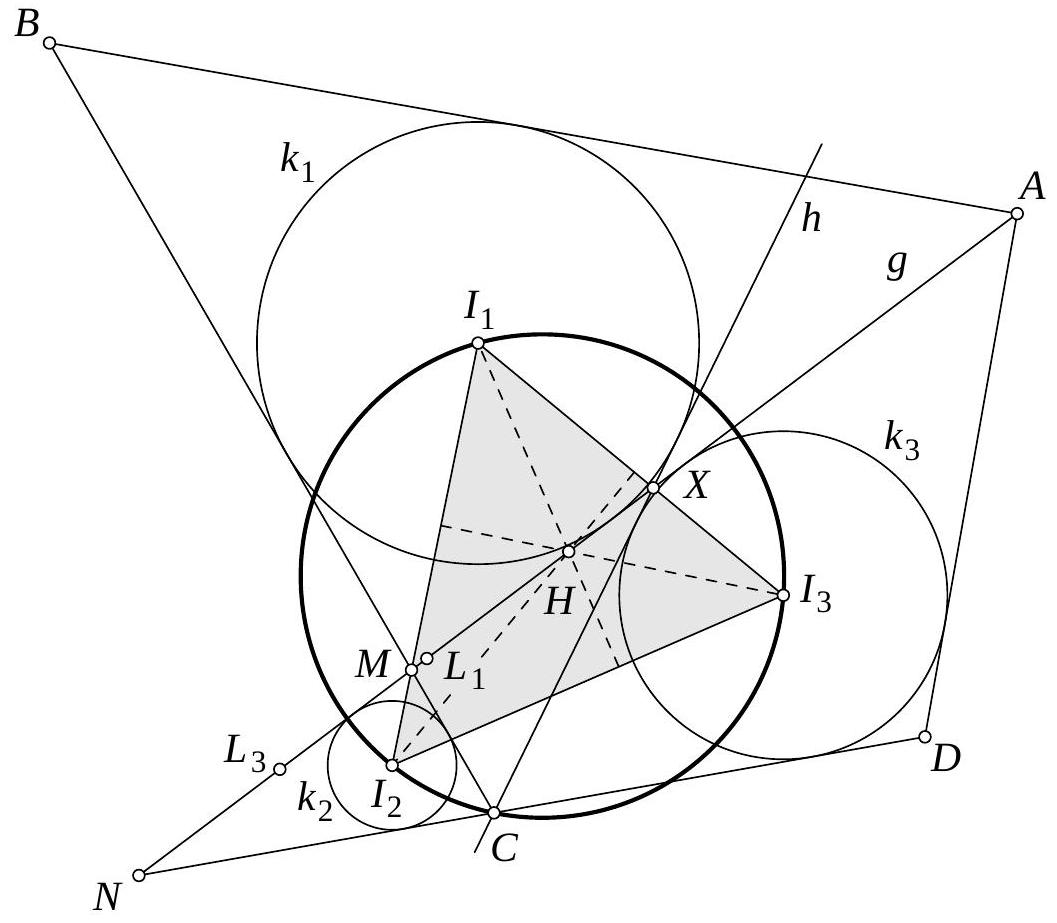
Let k1,k2k_{1}, k_{2} and k3k_{3} be the incircles of triangles ABMABM, MNCMNC, and NDANDA, respectively (see Figure 1). We shall show that the tangent hh from CC to k1k_{1} which is different from CBCB is also tangent to k3k_{3}.

Figure 1
Figure 1

To this end, let XX denote the point of intersection of gg and hh. Then ABCXABCX and ABCDABCD are circumscribed quadrilaterals, whence
CDCX=(AB+CD)(AB+CX)=(BC+AD)(BC+AX)=ADAX, CD - CX = (AB + CD) - (AB + CX) = (BC + AD) - (BC + AX) = AD - AX,
i.e.
AX+CD=CX+AD AX + CD = CX + AD
which in turn reveals that the quadrilateral AXCDAXCD is also circumscribed. Thus hh touches indeed the circle k3k_{3}.

Moreover, we find that I3CI1=I3CX+XCI1=12(DCX+XCB)=12DCB=12(180MCN)=180MI2N=I3I2I1\angle I_{3} C I_{1} = \angle I_{3} CX + \angle XCI_{1} = \frac{1}{2}(\angle DCX + \angle XCB) = \frac{1}{2} \angle DCB = \frac{1}{2}(180^{\circ} - \angle MCN) = 180^{\circ} - \angle MI_{2}N = \angle I_{3} I_{2} I_{1}, from which we conclude that C,I1,I2,I3C, I_{1}, I_{2}, I_{3} are concyclic.

Let now L1L_{1} and L3L_{3} be the reflection points of CC with respect to the lines I2I3I_{2} I_{3} and I1I2I_{1} I_{2} respectively. Since I1I2I_{1} I_{2} is the angle bisector of NMC\angle NMC, it follows that L3L_{3} lies on gg. By analogous reasoning, L1L_{1} lies on gg.

Let HH be the orthocenter of I1I2I3\triangle I_{1} I_{2} I_{3}. We have I2L3I1=I1CI2=I1I3I2=180I1HI2\angle I_{2} L_{3} I_{1} = \angle I_{1} C I_{2} = \angle I_{1} I_{3} I_{2} = 180^{\circ} - \angle I_{1} H I_{2}, which entails that the quadrilateral I2HI1L3I_{2} H I_{1} L_{3} is cyclic. Analogously, I3HL1I2I_{3} H L_{1} I_{2} is cyclic.

Then, working with oriented angles modulo 180180^{\circ}, we have
L3HI2=L3I1I2=I2I1C=I2I3C=L1I3I2=L1HI2, \angle L_{3} H I_{2} = \angle L_{3} I_{1} I_{2} = \angle I_{2} I_{1} C = \angle I_{2} I_{3} C = \angle L_{1} I_{3} I_{2} = \angle L_{1} H I_{2},
whence L1,L3L_{1}, L_{3}, and HH are collinear. By L1L3L_{1} \neq L_{3}, the claim follows.

Solution 2

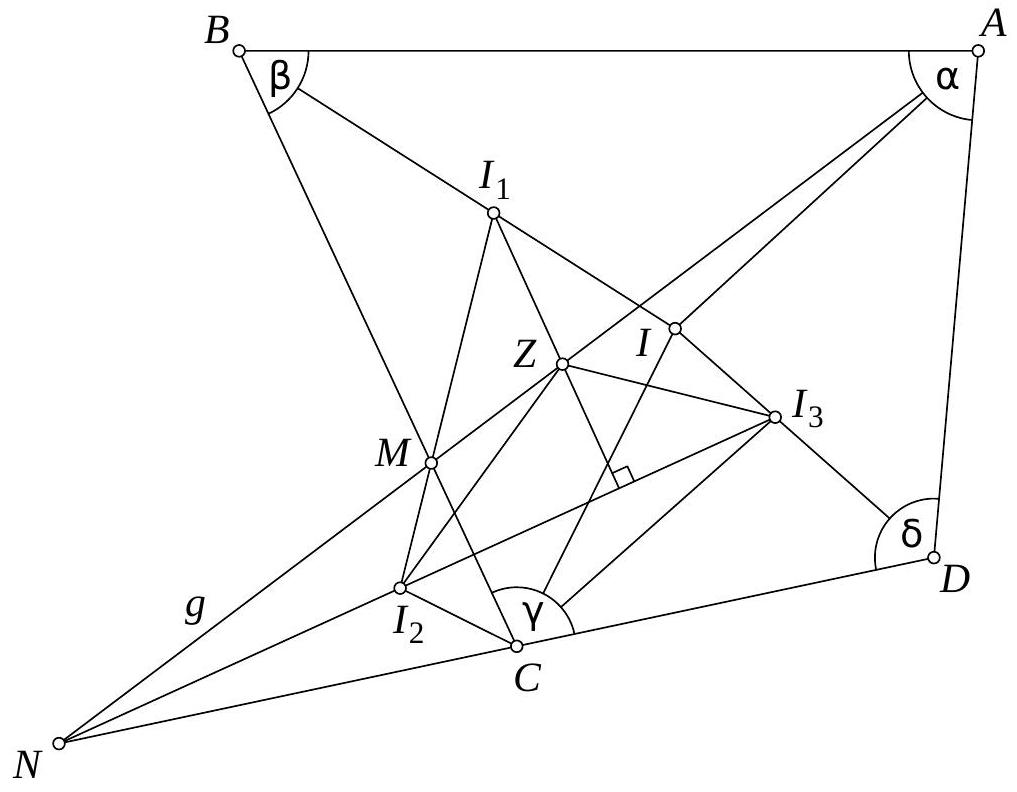
We start by proving that C,I1,I2C, I_{1}, I_{2}, and I3I_{3} are concyclic.

Figure 2
Figure 2

To this end, notice first that I2,M,I1I_{2}, M, I_{1} are collinear, as are N,I2,I3N, I_{2}, I_{3} (see Figure 2). Denote by α,β,γ,δ\alpha, \beta, \gamma, \delta the internal angles of ABCDABCD. By considerations in triangle CMNCMN, it follows that I3I2I1=γ2\angle I_{3} I_{2} I_{1} = \frac{\gamma}{2}. We will show that I3CI1=γ2\angle I_{3} C I_{1} = \frac{\gamma}{2}, too. Denote by II the incenter of ABCDABCD. Clearly, I1BII_{1} \in BI, I3DII_{3} \in DI, I1AI3=α2\angle I_{1} A I_{3} = \frac{\alpha}{2}.

Using the abbreviation [X,YZ][X, YZ] for the distance from point XX to the line YZYZ, we have because of BAI1=IAI3\angle BAI_{1} = \angle IAI_{3} and I1AI=I3AD\angle I_{1} AI = \angle I_{3} AD that
[I1,AB][I1,AI]=[I3,AI][I3,AD] \frac{[I_{1}, AB]}{[I_{1}, AI]} = \frac{[I_{3}, AI]}{[I_{3}, AD]}
Furthermore, consideration of the angle sums in AIBAIB, BICBIC, CIDCID and DIADIA implies AIB+CID=BIC+DIA=180\angle AIB + \angle CID = \angle BIC + \angle DIA = 180^{\circ}, from which we see
[I1,AI][I3,CI]=I1II3I=[I1,CI][I3,AI] \frac{[I_{1}, AI]}{[I_{3}, CI]} = \frac{I_{1}I}{I_{3}I} = \frac{[I_{1}, CI]}{[I_{3}, AI]}
Because of [I1,AB]=[I1,BC][I_{1}, AB] = [I_{1}, BC], [I3,AD]=[I3,CD][I_{3}, AD] = [I_{3}, CD], multiplication yields
[I1,BC][I3,CI]=[I1,CI][I3,CD] \frac{[I_{1}, BC]}{[I_{3}, CI]} = \frac{[I_{1}, CI]}{[I_{3}, CD]}
By DCI=ICB=γ/2\angle DCI = \angle ICB = \gamma / 2 it follows that I1CB=I3CI\angle I_{1} CB = \angle I_{3} CI which concludes the proof of the above statement.

Let the perpendicular from I1I_{1} on I2I3I_{2} I_{3} intersect gg at ZZ. Then MI1Z=90I3I2I1=90γ/2=MCI2\angle MI_{1}Z = 90^{\circ} - \angle I_{3} I_{2} I_{1} = 90^{\circ} - \gamma / 2 = \angle MCI_{2}. Since we have also ZMI1=I2MC\angle ZMI_{1} = \angle I_{2} MC, triangles MZI1MZI_{1} and MI2CMI_{2}C are similar. From this one easily proves that also MI2ZMI_{2}Z and MCI1MCI_{1} are similar. Because C,I1,I2C, I_{1}, I_{2}, and I3I_{3} are concyclic, MZI2=MI1C=NI3C\angle MZI_{2} = \angle MI_{1}C = \angle NI_{3}C, thus NI2ZNI_{2}Z and NCI3NCI_{3} are similar, hence NCI2NCI_{2} and NI3ZNI_{3}Z are similar. We conclude ZI3I2=I2CN=90γ/2\angle ZI_{3}I_{2} = \angle I_{2}CN = 90^{\circ} - \gamma / 2, hence I1I2ZI3I_{1} I_{2} \perp ZI_{3}. This completes the proof.

Want a route through all this instead of an archive? The track puts 2,000 problems in a working order, from AMC 10 level to the IMO shortlist.

Source: MathNet, licensed CC-BY-4.0. Statement and solution reproduced as published; topic and difficulty added by this site.