1) First, notice that ∠AFB=∠AFE+∠BFE=∠ADB+∠ACB=∠AOB, then A,F,O,B are concyclic. Similarly, D,F,O,C are also concyclic.
By considering three radical axes of three circles (O), (ABOF), (CDFO), we can see that three lines AB, CD, FO are concurrent at S which implies that S,F,O are collinear. We have
∠EFO=∠AFO−∠AFE=180∘−∠ABO−∠ADB=180∘−∠ABO−21∠AOB=90∘.
Then SF⊥EF.
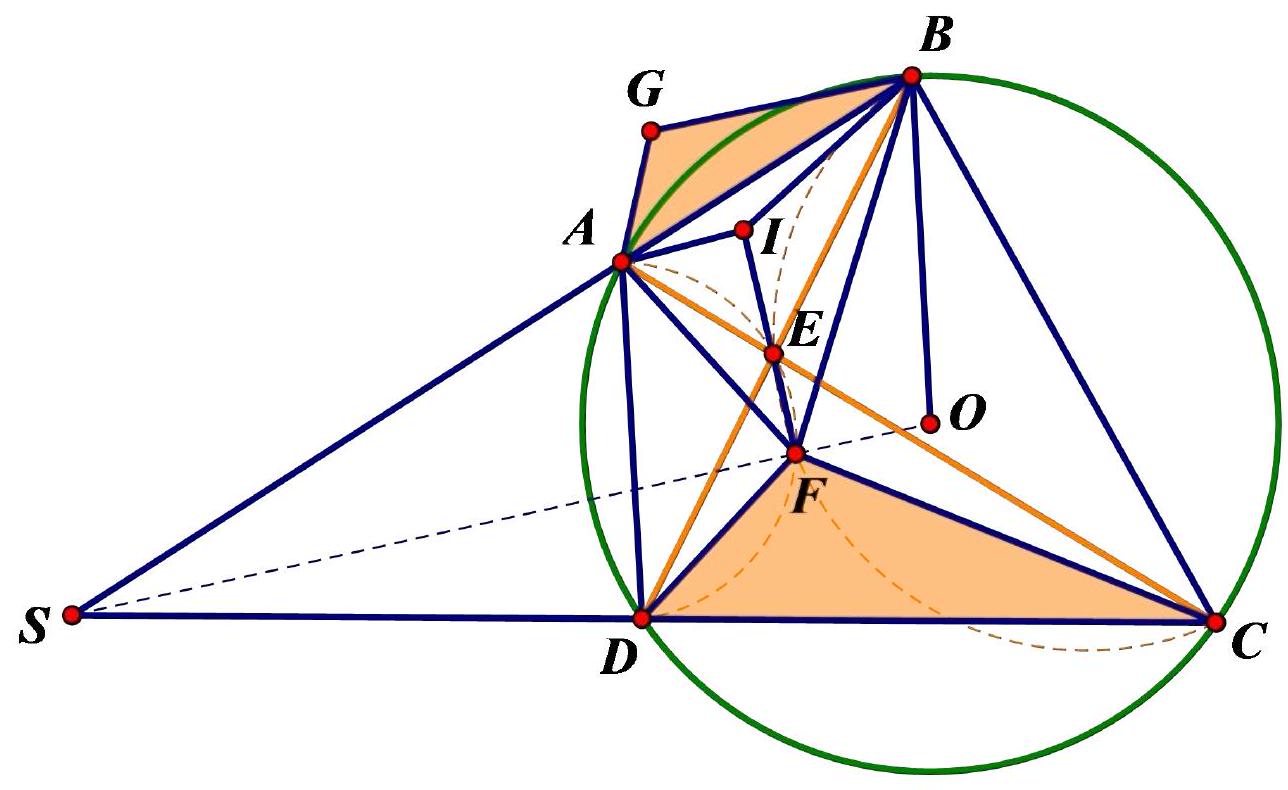
2) Suppose that the angle bisectors of ∠GAF, ∠GBF intersect at I. We shall prove that I,E,F are collinear. Indeed, we have
∠IAG=∠IAF⇔∠GAB+∠IAB=∠IAE+∠EAF⇔∠FDC+∠EDF+∠IAB=∠IAE+2∠EAF⇔∠EDC−∠IAE+∠IAB=2∠EAF⇔2∠IAB=2∠EAF⇔∠IAB=∠EAF
Hence, IA, EA are isogonal conjugate in angle ∠BAF. Similarly, IB, EB are isogonal conjugate in angle ∠ABF. Then IF, EF also are isogonal conjugate in angle ∠AFB. But EF is the bisector of angle ∠AFB then I,E,F are collinear and IF is the angle bisector of ∠AFB.
In quadrilateral GAFB, we have three internal angle bisectors are concurrent at I then this quadrilateral is circumscribed, which means GA+FB=GB+FA. □