Convex quadrilateral ABCD is inscribed in circle ω. Rays AB and DC intersect at K. L is chosen on the diagonal BD so that . M is chosen on the segment KL so that . Prove that the line touches . (Kungozhin M.)
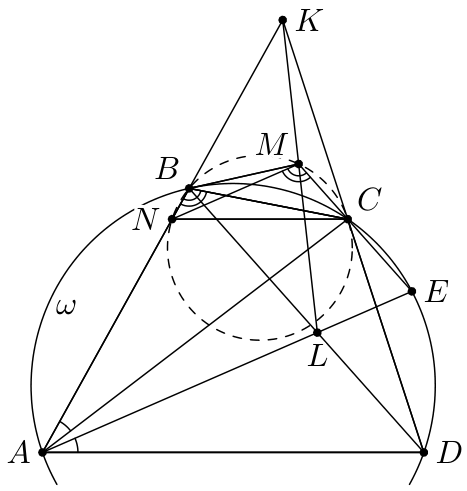
Convex quadrilateral ABCD is inscribed in circle ω. Rays AB and DC intersect at K. L is chosen on the diagonal BD so that . M is chosen on the segment KL so that . Prove that the line touches . (Kungozhin M.)
Let N be a point on the line so that . Since and , it follows that is a center of homothety which sends into similar . On the other hand, is similar to because and . Consequently, , and thus points , , , are cyclic. Therefore, from which it follows that touches .
For this solution we need the following theorem.
Pascal's theorem. Points , , , , , (not necessarily in this order) lie on some circle. Then the intersections of the lines and , and , and lie on a straight line.
Back to the problem. Let be the second intersection of the line and . Define as a tangent line to at . Let's apply Pascal's theorem on points , , , , , (here coincides with ) and pairs of lines (, ), (, ), (, ). These pairs of lines coincide with pairs of lines (, ), (, ), (, ). Then from Pascal's theorem, the straight line connecting and will also contain . Since , it follows that touches , as desired.