Maths Olympiad Prep

Library / /19 of 42

Geometry Difficulty 5.9 AIME, harder Prove it Ireland

Suppose ABC is an isosceles triangle with b=cb = c. Show that 4bc>a24bc > a^2. Give an example of a right-angled triangle with hypotenuse aa in which this inequality fails.

Solution

By the triangle inequality, a<b+ca < b + c, hence a<2ba < 2b, using b=cb = c. Therefore a2<4bca^2 < 4bc, as required.

If x>1x > 1, and a=x2+1a = x^2 + 1, b=2xb = 2x, c=x21c = x^2 - 1, then
b2+c2=4x2+(x42x2+1)=x4+2x2+1=a2, b^2 + c^2 = 4x^2 + (x^4 - 2x^2 + 1) = x^4 + 2x^2 + 1 = a^2,
and so aa, bb, cc are side lengths of a right-angled triangle with hypotenuse aa. Then
a24bc=(x2+1)28x(x21)=x48x3+2x2+8x+1=x3(x8)+2x2+8x+1. \begin{aligned} a^2 - 4bc &= (x^2 + 1)^2 - 8x(x^2 - 1) \\ &= x^4 - 8x^3 + 2x^2 + 8x + 1 \\ &= x^3(x - 8) + 2x^2 + 8x + 1. \end{aligned}
Clearly, the polynomial x3(x8)+2x2+8x+1x^3(x-8)+2x^2+8x+1 is positive if xx is large enough, e.g., any x8x \ge 8 will do. So, as long as x8x \ge 8 we have a right-angled triangle in which a2>4bca^2 > 4bc.

Alternatively, we may find such examples as follows. If aa is the length of the hypotenuse of the right-angled triangle ABCABC, its area (ABCABC) is equal to bc/2bc/2. Hence, the desired inequality a2>4bca^2 > 4bc is equivalent to a2>8(ABC)a^2 > 8(ABC). If hh is the height of triangle ABCABC on the hypotenuse aa, then (ABCABC) = ah/2ah/2 and the desired inequality becomes a>4ha > 4h. In the diagram below, this means that AA should be on the semicircle but not above the dashed line.
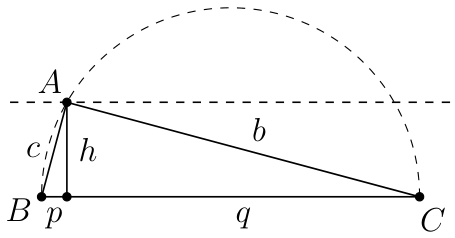
Figure 1
To make this more explicit, let the foot of the altitude from AA divide the hypotenuse into segments of length pp and qq, and recall that h2=pq=p(ap)h^2 = pq = p(a-p). Thus, we want a2>16h2=16p(ap)a^2 > 16h^2 = 16p(a-p), i.e. a216pa+16p2>0a^2 - 16pa + 16p^2 > 0. This is equivalent to
(ap8)2>48, i.e. ap8>43. \left(\frac{a}{p} - 8\right)^2 > 48, \text{ i.e. } \left|\frac{a}{p} - 8\right| > 4\sqrt{3}.
As 0<p<a0 < p < a in our case, given aa we can choose any pp such that
0<p<234or2+34<p<a. 0 < p < \frac{2 - \sqrt{3}}{4} \quad \text{or} \quad \frac{2 + \sqrt{3}}{4} < p < a.
Because c2=p2+h2=p(p+q)=apc^2 = p^2 + h^2 = p(p+q) = ap and b2=aq=a(ap)b^2 = aq = a(a-p), the value of pp determines b=a2apb = \sqrt{a^2 - ap} and c=apc = \sqrt{ap} for any given aa. For example, with a=41a = 41 and p=81/41p = 81/41, we obtain b=40b = 40 and c=9c = 9. In this example, a2=1681>1440=4bca^2 = 1681 > 1440 = 4bc.

Want a route through all this instead of an archive? The track puts 2,000 problems in a working order, from AMC 10 level to the IMO shortlist.

Source: MathNet, licensed CC-BY-4.0. Statement and solution reproduced as published; topic and difficulty added by this site.