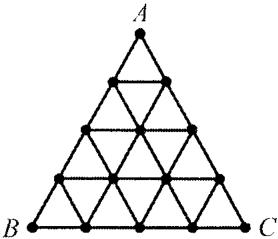
Let be a positive integer. An equilateral triangle is divided into identical equilateral "small" triangles using lines parallel to its sides. The figure below illustrates the case . Let be the number of rhombi consisting of 2 "small" triangles. Let be the number of rhombi consisting of 8 "small" triangles. Find the difference in terms of .
XV-th Junior Balkan Mathematical Olympiad
Solution
Each line segment with ends from the set of length (not lying on a side of the triangle) is the diagonal of one and only one rhombus of type . The segments parallel to one side of the triangle are
Therefore, the total number of rhombi of type is:
For the counting of rhombi of type , we distinguish the points of which are interior points of the triangle into three categories as follows.
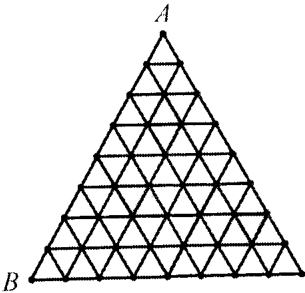
The first category of points are centers of exactly one rhombus of type . These points are only 3, for every . In figure (3) you can see the case for .
The second category consists of points which are centers of exactly two rhombi of type . These points lie on the segments which are parallel to the sides of the triangle and at the shortest possible distance from them. On each such segment there exist such points, and therefore we have points of this category. In figure (4) you can see these points for .
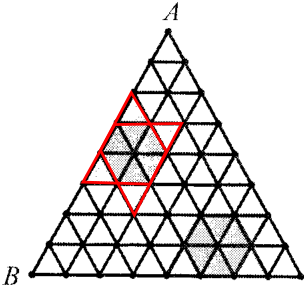
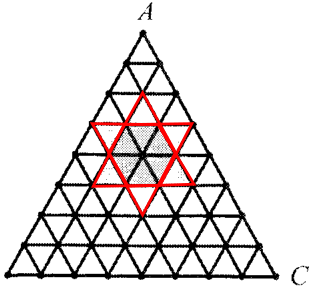
The third category consists of the rest of the points which are centers of three rhombi of type . These points are totally:
In figure (5) you can see these points for .
Hence, the number of rhombi of type is the following:
Finally, we have .
Want a route through all this instead of an archive? The track
puts 2,604 problems in a working order, from Junior Challenge level to the IMO shortlist.