Let be a convex hexagon such that , and suppose that the line segments , , and have the same perpendicular bisector. Let the diagonals and meet at , and denote by the circle . Let intersect the circle again at . Prove that the lines and intersect on .
International Mathematical Olympiad
Solutions — 2
Solution 1
Solution 1. If , then the hexagon is symmetric about the line ; in particular the circles and are tangent to each other. So and must be different. Since the points and can be interchanged with and , respectively, we may assume .
Let be the radical center of the circles and , and the circumcircle of the symmetric trapezoid ; that is the common point of the pairwise radical axes , , and . By the symmetry of and , the point lies on the common perpendicular bisector of and , which is the external bisector of .
Let be the second intersection of the line and the circle . From the power of with respect to the circles and we have , so the points and are concyclic.
The line is the external bisector of , so the point bisects the . By , on circle , the point is the midpoint of ; let be the point diametrically opposite to , that is the midpoint of the opposite of . Notice that the points and lie on the perpendicular bisector of , so they are collinear.
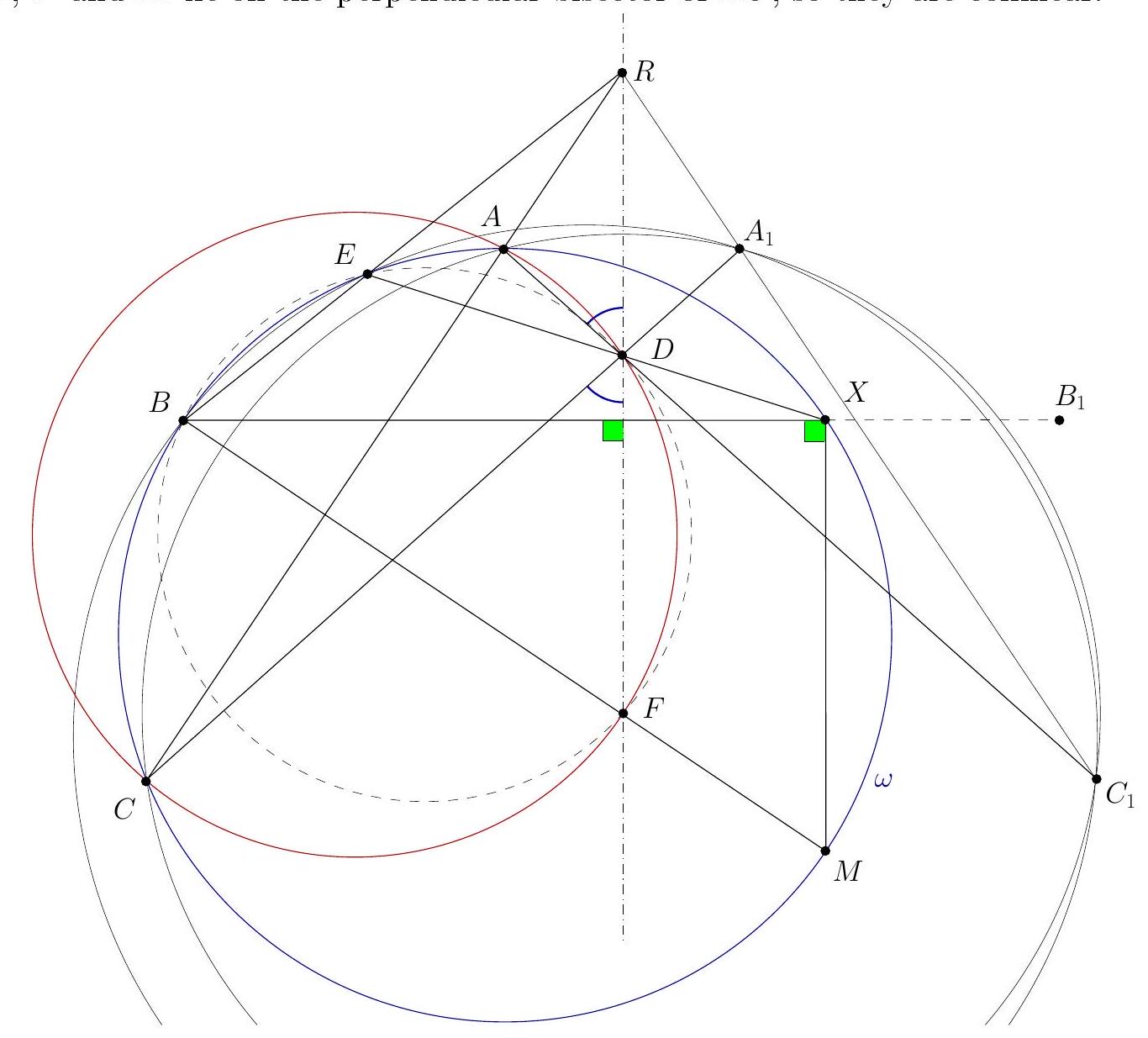
Finally, let be the second intersection point of and the line . Since is a diameter in , we have . Moreover,
so and are parallel. Since is perpendicular to and is perpendicular to , this shows that lies on line .
Solution 2
Solution 2. Define point as the point opposite to on circle , and point as the intersection of lines , and , and show that lies on the external bisector of , like in the first solution.
Since is the midpoint of the , the line is the external bisector of . Now we show that the internal angle bisectors of and meet on the segment . Let the angle bisector of meet at , and let the angle bisector of , which is line , meet at . By applying the angle bisector theorem to both internal and external bisectors of and ,
so indeed .
By the points and are concyclic.
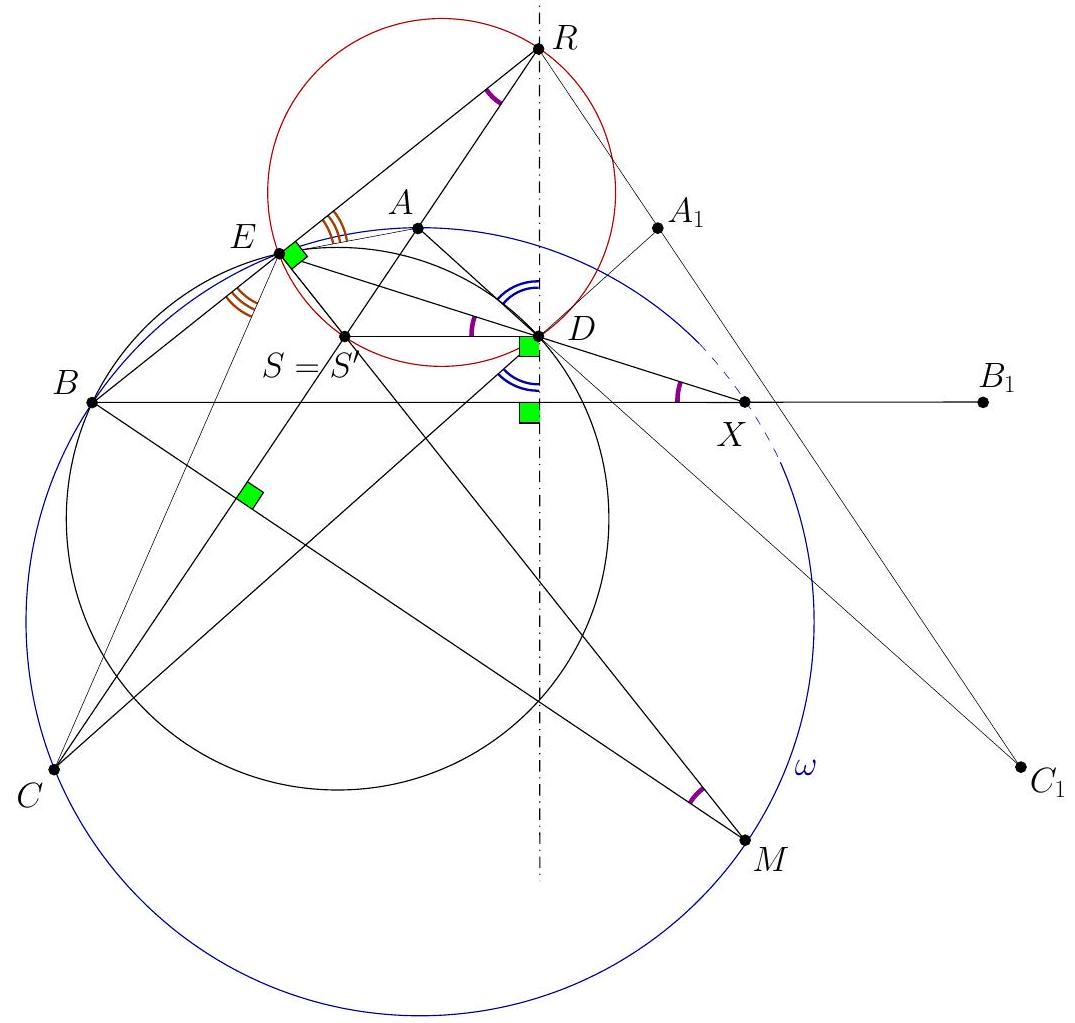
Now let the lines and meet at point . Notice that because both and are perpendicular to the line , we have that in circle , and because and . Therefore, , so indeed, the point lies on .
Want a route through all this instead of an archive? The track
puts 2,604 problems in a working order, from Junior Challenge level to the IMO shortlist.