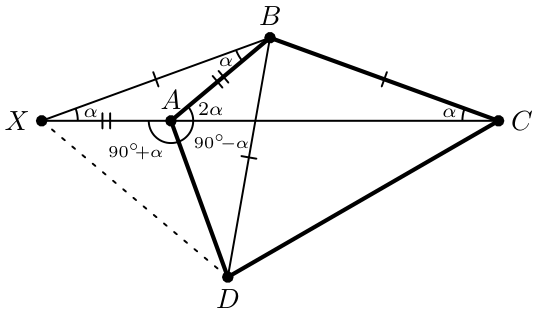
Let ABCD be a convex quadrilateral that satisfies the following conditions: ∠BAC=2∠BCA,∠BCA+∠CAD=90∘andBC=BD. Find ∠ADB.
Solution
Let ∠BCA=α and X be a point on ray CA such that BX=BC. Since BX=BC, we have that ∠BXC=α, and using that ∠BAC=∠AXB+∠ABX, we obtain that ∠ABX=α and hence AX=AB. We can observe that ∠XAD=∠DAB, as ∠XAD=180∘−∠DAC=90∘+α, ∠DAB=90∘−α+2α=90∘+α. Therefore, using SAS congruence we have △XAD≅△BAD, and XD=DB. This shows that △XDB is equilateral, and ∠XDA=∠ADB=30∘.
Want a route through all this instead of an archive? The track
puts 2,604 problems in a working order, from Junior Challenge level to the IMO shortlist.
Source: MathNet,
licensed CC-BY-4.0.
Statement reproduced verbatim; metadata (topic, difficulty) added by this project.