A convex polygon in the plane is dissected into smaller convex polygons by drawing all of its diagonals. The lengths of all sides and all diagonals of the polygon are rational numbers. Prove that the lengths of all sides of all polygons in the dissection are also rational numbers.
USA IMO, 2003
Solution
Let , where is an integer with . The problem is trivial for because there are no diagonals and thus no dissections. We assume that . Our proof is based on the following Lemma.
Lemma Let be a convex quadrilateral such that all its sides and diagonals have rational lengths. If segments and meet at , then segments , , , all have rational lengths.
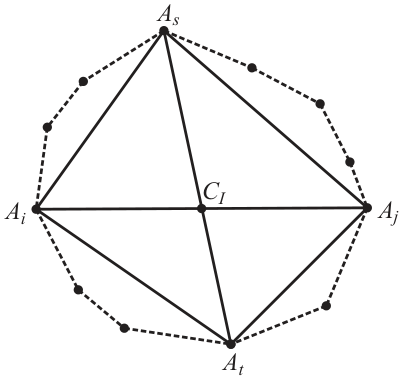
It is clear by the Lemma that the desired result holds when is a convex quadrilateral. Let () be a diagonal of . Assume that are the consecutive division points on diagonal (where point is the closest to vertex and is the closest to ). Then the segments , , are the sides of all polygons in the dissection. Let be the point where diagonal meets diagonal . Then quadrilateral satisfies the conditions of the Lemma. Consequently, segments and have rational lengths. Therefore, segments all have rational lengths. Thus, is rational. Because are arbitrarily chosen, we proved that all sides of all polygons in the dissection are also rational numbers.
Now we present two proofs of the Lemma to finish our proof.
* First approach We show only that segment is rational, the proof for the others being similar. Introduce Cartesian coordinates with and . Put and . Then by hypothesis, the numbers
are rational. In particular,
is rational. Because , is rational. Likewise, is rational.
Now we have that , , and are rational, and so that is rational. Because quadrilateral is convex, and are nonzero and have opposite sign. Hence is rational.
We now calculate
so
is rational.
* Second approach To prove the Lemma, we set and . Applying the Law of Cosines to triangles , , shows that angles all have rational cosine values. By the Addition formula, we have
implying that is rational.
Thus
is rational.
Note that the ratio between the areas of triangles ADP and ABP is equal to . Therefore
implying that is rational. Because is rational, both and are rational. Similarly, and are rational, proving the Lemma.
Want a route through all this instead of an archive? The track
puts 2,604 problems in a working order, from Junior Challenge level to the IMO shortlist.