Maths Olympiad Prep

Library / /5 of 9

Geometry Difficulty 4.3 AIME Prove it Japan

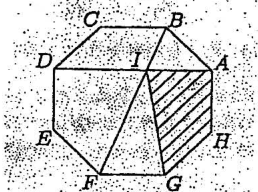
A regular octagon ABCDEFGHABCDEFGH of side length 11 is given. Let II be the point of intersection of the lines ADAD and BFBF. Find the area of the quadrilateral AIGHAIGH.

Figure 1

Solution

1+22 \boxed{\frac{1 + \sqrt{2}}{2}}
Since the straight lines CHCH and ADAD are symmetrically positioned with respect to the straight line BFBF, the lines CHCH, ADAD, BFBF intersect at a single point. Therefore, the 33 points CC, II, HH lie on the same straight line. Since the diagonals DHDH and CGCG are diameters of the circum-circle of the octagon, we have DAH=CHG=90\angle DAH = \angle CHG = 90^\circ. Since BCADBC \parallel AD and BACHBA \parallel CH are satisfied, the quadrilateral ABCIABCI is a parallelogram, and hence we get AI=BC=1AI = BC = 1. From IAH=90\angle IAH = 90^\circ we get IH=AI2+AH2=2IH = \sqrt{AI^2 + AH^2} = \sqrt{2}. Consequently, the area of the triangle AIHAIH is 12AIAH=12\frac{1}{2} \cdot AI \cdot AH = \frac{1}{2},

and since IHG=90\angle IHG = 90^\circ, the area of the triangle HIG=12HIHG=22HIG = \frac{1}{2} \cdot HI \cdot HG = \frac{\sqrt{2}}{2}. We then conclude that the area of the quadrilateral AIGH=12+22=1+22AIGH = \frac{1}{2} + \frac{\sqrt{2}}{2} = \frac{1+\sqrt{2}}{2}.

Alternate Solution:
Since AGBFAG\parallel BF, the areas of the triangles AIGAIG and AFGAFG are the same. Hence it is enough to determine the area of the quadrilateral AFGHAFGH.
Let JJ be the point of intersection of the straight lines AHAH and FGFG. Then we have JHG=JGH=180135=45\angle JHG = \angle JGH = 180^\circ - 135^\circ = 45^\circ, and we see that the triangle JHGJHG is a right isosceles triangle with GJH=90\angle GJH = 90^\circ. Consequently, we have JH=JG=22JH = JG = \frac{\sqrt{2}}{2}.
Putting together what we obtained above, we get that the area of the triangle JAF=12JAJF=12(1+22)2=3+224JAF = \frac{1}{2} \cdot JA \cdot JF = \frac{1}{2} \cdot (1 + \frac{\sqrt{2}}{2})^2 = \frac{3+2\sqrt{2}}{4}, and the area of the triangle JHG=12JHJG=12(22)2=14JHG = \frac{1}{2} \cdot JH \cdot JG = \frac{1}{2} (\frac{\sqrt{2}}{2})^2 = \frac{1}{4}. And finally, the area of the quadrilateral AFGH=3+22414=1+22AFGH = \frac{3+2\sqrt{2}}{4} - \frac{1}{4} = \frac{1+\sqrt{2}}{2}, which is the desired answer.

Want a route through all this instead of an archive? The track puts 2,000 problems in a working order, from AMC 10 level to the IMO shortlist.

Source: MathNet, licensed CC-BY-4.0. Statement and solution reproduced as published; topic and difficulty added by this site.