Given an n×n square table. Exactly one beetle sits in each cell of the table. At 12.00 all beetles creep to some neighboring cell (two cells are neighboring if they have the common side). Find the greatest number of cells which can become empty (i.e. without beetles) if
a) n=8; b) n=9.
(Problem Committee of BMO 2011)
Solution
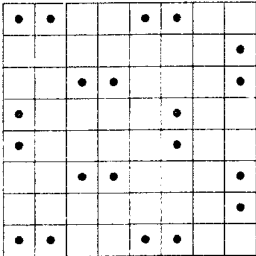
a) Answer: 44. (Solution of A. Zhuk, O. Volod'ko.) Let's mark 20 cells of the table as it is shown in Fig. 1. It is obvious that all beetles from the marked cells after their moves must occupy different cells. That is, at least 20 cells will remain occupied, so at most 64−20=44 cells can become empty. On the other hand, it is easy to see that after moves all beetles can occupy the marked cells, so the beetles can make at least 44 empty cells.
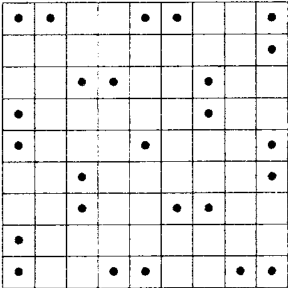
b) Answer: 56. As in a), solution follows from Fig. 2 with 25 marked cells. So the answer is 81−25=56.
Want a route through all this instead of an archive? The track
puts 2,604 problems in a working order, from Junior Challenge level to the IMO shortlist.
Source: MathNet,
licensed CC-BY-4.0.
Statement reproduced verbatim; metadata (topic, difficulty) added by this project.