a.
We denote the angles of △ABC by ∠A, ∠B, ∠C. Since AI is a diameter, we have ∠ACI=∠ABI=90∘. Also, ∠AIC=∠B (both standing on arc AC), and ∠CAI=∠CBI (both standing on arc CI). Therefore,
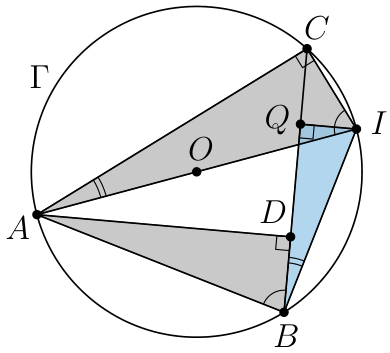
△ACI∼△ADB∼△BQI. Similarly, △ABI∼△ADC∼△CQI and
∣CI∣∣AC∣=∣DB∣∣AD∣=∣QI∣∣BQ∣as well as∣BI∣∣AB∣=∣DC∣∣AD∣=∣QI∣∣CQ∣
which gives ∣AD∣⋅∣QI∣=∣CD∣⋅∣CQ∣=∣BD∣⋅∣BQ∣.
b.
Solution 1:
Let X denote the intersection point of AI and BC. Then, by power of X with respect to the circumcircle of ABC (or △AXB∼△CXI) we have ∣AX∣⋅∣XI∣=∣CX∣⋅∣XB∣. By power of X with respect to the circumcircle of CBO, we have ∣OX∣⋅∣XP∣=∣CX∣⋅∣XB∣. Combining both equations, we obtain
∣OX∣⋅∣XP∣=∣AX∣⋅∣XI∣i.e.∣OX∣∣AX∣=∣XI∣∣XP∣
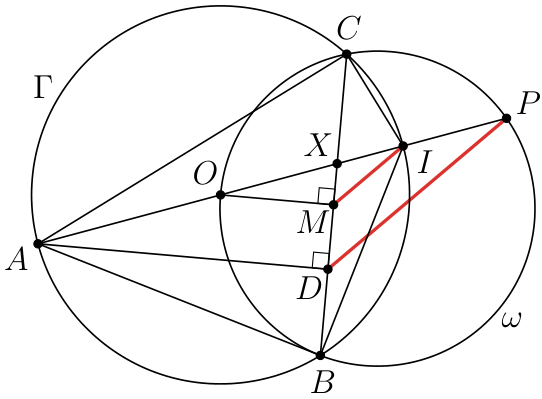
By the Intercept Theorem, or △OMX∼△ADX, we have
∣OX∣∣AX∣=∣MX∣∣DX∣,hence∣XI∣∣XP∣=∣MX∣∣DX∣
This implies similarity of triangles MXI and DXP, hence MI∥DP.
Solution 2:
Substituting ∣CD∣=∣BC∣−∣BD∣ and ∣BQ∣=∣BC∣−∣CQ∣ in the equation ∣CD∣⋅∣CQ∣=∣BD∣⋅∣BQ∣ from part (a) yields ∣BD∣=∣CQ∣. Since M is the midpoint of BC, it is then also the midpoint of DQ. We define J on the extended line QI such that I is the midpoint of segment QJ. Then MI∥DJ (mid-line in △DQJ). It remains to prove that J is on the line DP.
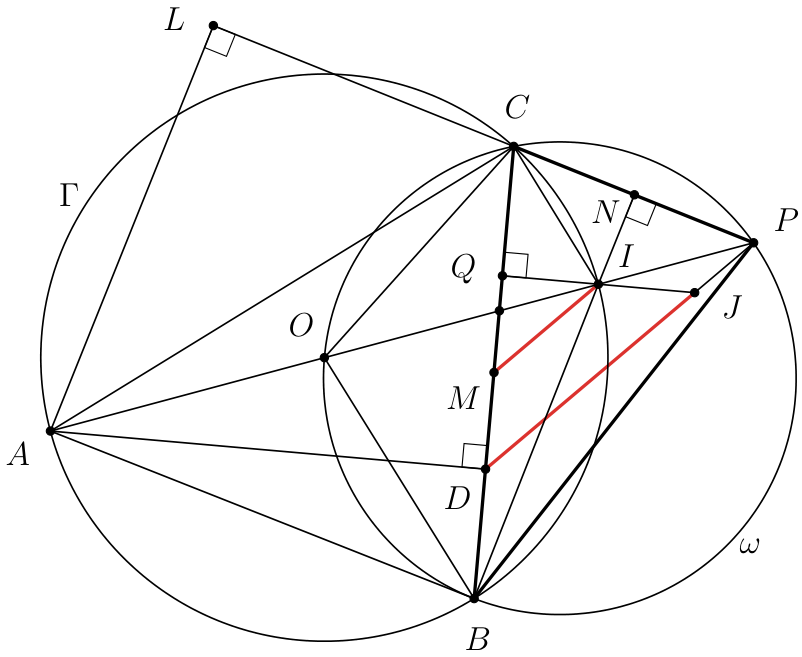
We first prove that I is the incentre of △CPB. Indeed, we have
∠CBP=∠COP and ∠BCP=∠BOP in ω
∠COP=2∠CBI and ∠BOP=2∠BCI in Γ
so ∠CBP=2∠CBI and ∠BCP=2∠BCI hence BI and CI are angle bisectors and I is the incentre of △CPB.
Because AI is a diameter of Γ, AC⊥CI and AB⊥BI. Therefore, AC and AB are external angle bisectors of △CPB and so A is an excentre.
Consider the inradius and exradius given by IN and AL, both perpendicular to PC. Then triangles △PNI and △PLA are similar, which implies
∣PA∣∣PI∣=∣AL∣∣IN∣=∣AD∣∣IQ∣=∣AD∣∣IJ∣.
Because IJ is parallel to AD, we have ∠PIJ=∠PAD. Hence, triangles △PIJ and △PAD are similar and P, J, D are collinear.
Solution 3:
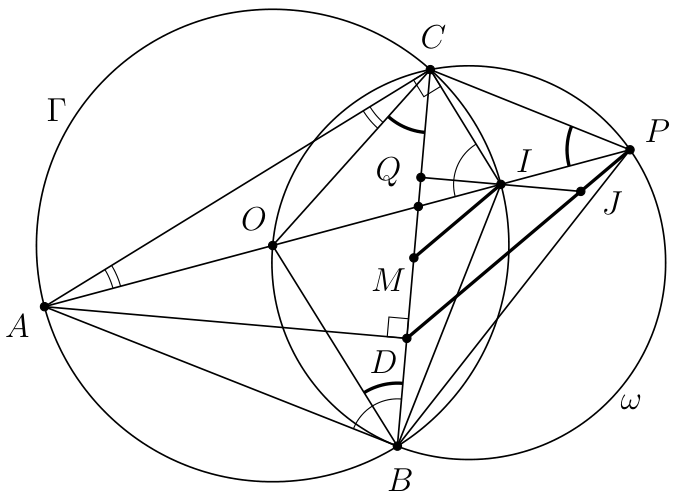
From (a) we get ∣BD∣=∣CQ∣, see Solution 2. This implies ∣BQ∣=∣CD∣ and that M is the midpoint of QD. We extend the line QI to intersect PD at J. To prove MI∥PD, it is sufficient to show ∣QI∣=∣IJ∣. This is equivalent to ∣AD∣∣QI∣=∣PA∣∣PI∣, because ∣AD∣∣IJ∣=∣PA∣∣PI∣ follows from QJ∥AD.
Using (a), we obtain
∣AD∣∣QI∣=∣AD∣2∣BD∣⋅∣BQ∣=∣AD∣2∣BD∣⋅∣CD∣=cotBcotC.
On the other hand,
∣PA∣∣PI∣=[CPA][CPI]=21∣CP∣⋅∣CA∣sin∠PCA21∣CP∣⋅∣CI∣sin∠PCI=∣CA∣sin∠PCA∣CI∣sin∠PCI,
and ∣CA∣∣CI∣=cot∠CIA=cotB, while
∠PCA=180∘−∠CAO−∠CPO=180∘−∠ACO−∠CBO=180∘−∠ACO−∠OCB=180∘−∠C
and so ∠PCI=∠PCA−90∘=90∘−∠C. Hence
sin∠PCAsin∠PCI=sin(180∘−∠C)sin(90∘−∠C)=sinCcosC=cotC.
Therefore,
∣PA∣∣PI∣=∣CA∣∣CI∣⋅sin∠PCAsin∠PCI=cotBcotC=∣AD∣∣QI∣,