Maths Olympiad Prep

Library / /20 of 27

Geometry Difficulty 6.8 National olympiad Prove it Brazil

Consider a regular nn-gon inscribed in the unit circle. Compute the sum of the areas of all triangles determined by the vertices of the nn-gon.

Solution

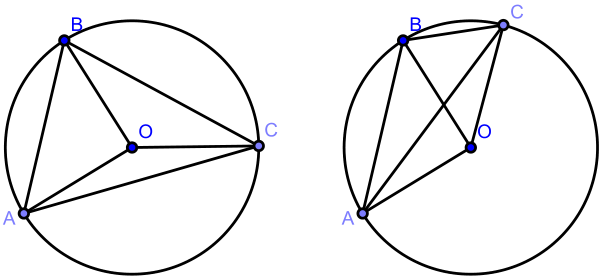
First consider a triangle ABCABC and its circumcenter OO. Then the area of ABCABC is R22(sin2A+sin2B+sin2C)\frac{R^2}{2}(\sin 2\angle A + \sin 2\angle B + \sin 2\angle C). Notice that if B>90\angle B > 90^\circ then sin2B<0\sin 2\angle B < 0.

Figure 1

So the sum is equal to the sum of the areas of triangles OAiAjOA_iA_j with a plus sign or a minus sign, depending on the third vertex AkA_k of the triangle AiAjAkA_iA_jA_k: if AkA_k lies on the major arc AiAjA_iA_j then we have a plus sign; else we have a minus sign (it won't matter if AiAjA_iA_j is a diameter, because in that case the area of OAiAjOA_iA_j is zero).

Therefore, if AiAjA_iA_j subtend a minor arc of k2πnk \cdot \frac{2\pi}{n}, 1kn/21 \le k \le \lfloor n/2 \rfloor, the area of the triangle OAiAjOA_iA_j appears with a minus sign k1k-1 times and with a plus sign n(k1)2=nk1n - (k-1) - 2 = n-k-1 times. So it contributes with the sum nk1(k1)=n2kn-k-1 - (k-1) = n-2k times.

Figure 1

S=n2k=1n/2(n2k)sinkθ=n22k=1n/2sinkθnk=1n/2ksinkθ S = \frac{n}{2} \sum_{k=1}^{\lfloor n/2 \rfloor} (n-2k) \sin k\theta = \frac{n^2}{2} \sum_{k=1}^{\lfloor n/2 \rfloor} \sin k\theta - n \sum_{k=1}^{\lfloor n/2 \rfloor} k \sin k\theta

Consider the sums S1(θ)=k=1n/2sinkθS_1(\theta) = \sum_{k=1}^{\lfloor n/2 \rfloor} \sin k\theta and S2(θ)=k=1n/2coskθ    S2(θ)=k=1n/2ksinkθS_2(\theta) = \sum_{k=1}^{\lfloor n/2 \rfloor} \cos k\theta \implies S_2'(\theta) = -\sum_{k=1}^{\lfloor n/2 \rfloor} k \sin k\theta. So we want to compute n22S1(θ)+nS2(θ)\frac{n^2}{2} S_1(\theta) + n \cdot S_2'(\theta).

S2(θ)+iS1(θ)=k=1n/2coskθ+isinkθ=k=1n/2ωk=ωωn/21ω1=ωn/2/2+1/2ωn/2/2ωn/2/2ω1/2ω1/2=(cos((n/2+1)θ2)+isin((n/2+1)θ2))sin(n/2θ/2)sin(θ/2), \begin{align*} S_2(\theta) + iS_1(\theta) &= \sum_{k=1}^{\lfloor n/2 \rfloor} \cos k\theta + i \sin k\theta = \sum_{k=1}^{\lfloor n/2 \rfloor} \omega^k = \omega \cdot \frac{\omega^{\lfloor n/2 \rfloor} - 1}{\omega - 1} \\ &= \omega^{\lfloor n/2 \rfloor/2+1/2} \frac{\omega^{\lfloor n/2 \rfloor/2} - \omega^{-\lfloor n/2 \rfloor/2}}{\omega^{1/2} - \omega^{-1/2}} \\ &= \left( \cos \left( \frac{(\lfloor n/2 \rfloor + 1)\theta}{2} \right) + i \sin \left( \frac{(\lfloor n/2 \rfloor + 1)\theta}{2} \right) \right) \cdot \frac{\sin(\lfloor n/2 \rfloor \theta/2)}{\sin(\theta/2)}, \end{align*}

S1=sin((n/2+1)θ2)sin(n/2θ2)sin(θ/2)=cos(θ/2)cos((n/2+1/2)θ)2sin(θ/2)=12cot(θ/2)cos((n/2+1/2)θ)2sin(θ/2)S2=cos((n/2+1)θ2)sin(n/2θ2)sin(θ/2)=sin(θ/2)+sin((n/2+1/2)θ)2sin(θ/2)=12+sin((n/2+1/2)θ)2sin(θ/2) \begin{aligned} S_1 &= \frac{\sin\left(\frac{(\lfloor n/2 \rfloor + 1) \theta}{2}\right) \sin\left(\frac{\lfloor n/2 \rfloor \theta}{2}\right)}{\sin(\theta/2)} = \frac{\cos(\theta/2) - \cos((\lfloor n/2 \rfloor + 1/2)\theta)}{2 \sin(\theta/2)} \\ &= \frac{1}{2} \cot(\theta/2) - \frac{\cos((\lfloor n/2 \rfloor + 1/2)\theta)}{2 \sin(\theta/2)} \\[1.5em] S_2 &= \frac{\cos\left(\frac{(\lfloor n/2 \rfloor + 1) \theta}{2}\right) \sin\left(\frac{\lfloor n/2 \rfloor \theta}{2}\right)}{\sin(\theta/2)} = \frac{\sin(\theta/2) + \sin((\lfloor n/2 \rfloor + 1/2)\theta)}{2 \sin(\theta/2)} \\ &= \frac{1}{2} + \frac{\sin((\lfloor n/2 \rfloor + 1/2)\theta)}{2 \sin(\theta/2)} \end{aligned}

S2(θ)=(n2+12)cos((n2+12)θ)sin(θ2)12cos(θ2)sin((n2+12)θ)2sin2(θ/2)=n/22cos((n/2+1/2)θ)sin(θ/2)14sin(n/2θ)sin2(θ/2) \begin{aligned} S_2'(\theta) &= \frac{\left(\lfloor \frac{n}{2} \rfloor + \frac{1}{2}\right) \cos\left(\left(\lfloor \frac{n}{2} \rfloor + \frac{1}{2}\right) \theta\right) \sin\left(\frac{\theta}{2}\right) - \frac{1}{2} \cos\left(\frac{\theta}{2}\right) \sin\left(\left(\lfloor \frac{n}{2} \rfloor + \frac{1}{2}\right) \theta\right)}{2 \sin^2(\theta/2)} \\ &= \frac{\lfloor n/2 \rfloor}{2} \frac{\cos((\lfloor n/2 \rfloor + 1/2)\theta)}{\sin(\theta/2)} - \frac{1}{4} \frac{\sin(\lfloor n/2 \rfloor \theta)}{\sin^2(\theta/2)} \end{aligned}

So the required sum is
n22(12cot(θ/2)cos((n/2+1/2)θ)2sin(θ/2))+n(n/22cos((n/2+1/2)θ)sin(θ/2)14sin(n/2θ)sin2(θ/2)) \frac{n^2}{2} \left( \frac{1}{2} \cot(\theta/2) - \frac{\cos((\lfloor n/2 \rfloor + 1/2)\theta)}{2 \sin(\theta/2)} \right) + n \left( \frac{\lfloor n/2 \rfloor}{2} \frac{\cos((\lfloor n/2 \rfloor + 1/2)\theta)}{\sin(\theta/2)} - \frac{1}{4} \frac{\sin(\lfloor n/2 \rfloor \theta)}{\sin^2(\theta/2)} \right)

If nn is even, n/2=n/2\lfloor n/2 \rfloor = n/2 and substituting θ=2πn\theta = \frac{2\pi}{n} the sum simplifies to
n24cotπn \frac{n^2}{4} \cot \frac{\pi}{n}
If nn is odd, n/2=(n1)/2\lfloor n/2 \rfloor = (n-1)/2 and substituting θ=2πn\theta = \frac{2\pi}{n} the sum also simplifies to
n24cotπn \frac{n^2}{4} \cot \frac{\pi}{n}

n24cotπn \frac{n^2}{4} \cot \frac{\pi}{n}

Want a route through all this instead of an archive? The track puts 2,000 problems in a working order, from AMC 10 level to the IMO shortlist.

Source: MathNet, licensed CC-BY-4.0. Statement and solution reproduced as published; topic and difficulty added by this site.