Maths Olympiad Prep

Library / /11 of 19

Geometry Difficulty 5.9 AIME, harder Prove it North Macedonia

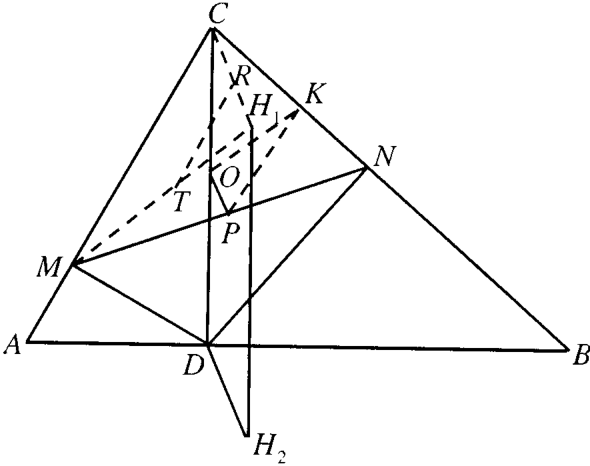
Consider an acute triangle ABCABC with area SS. Let CDABCD \perp AB (DABD \in AB), DMACDM \perp AC (MACM \in AC) and ENBCEN \perp BC (NBCN \in BC). Denote by H1H_1 and H2H_2 the orthocentres of the triangles MNCMNC and MNDMND respectively. Find the area of the quadrilateral AH1BH2AH_1BH_2 in terms of SS.

Figure 1

Solutions — 2

Solution 1

Let OO, PP, KK, RR and TT be the mid-points of the segments CDCD, MNMN, CNCN, CH1CH_1 and MH1MH_1, respectively. From MNC\triangle MNC we have that PK=12MC\overline{PK} = \frac{1}{2}\overline{MC} and PKMCPK \parallel MC.

Analogously, from MH1C\triangle MH_1C we have that TR=12MC\overline{TR} = \frac{1}{2}\overline{MC} and TRMCTR \parallel MC. Consequently, PK=TR\overline{PK} = \overline{TR} and PKTRPK \parallel TR. Also OKDN\overline{OK} \parallel \overline{DN} (from CDN\triangle CDN) and since DNBC\overline{DN} \perp \overline{BC} and MH1BC\overline{MH_1} \perp \overline{BC}, it follows that TH1OK\overline{TH_1} \parallel \overline{OK}. Since OO is the circumcenter of CMN\triangle CMN, OPMN\overline{OP} \perp \overline{MN}. Thus, CH1MNCH_1 \perp MN implies OPCH1\overline{OP} \parallel CH_1. We conclude TRH1KPO\triangle TRH_1 \cong \triangle KPO (they have parallel sides and TR=PK\overline{TR} = \overline{PK}), hence RH1=PO\overline{RH_1} = \overline{PO}, i.e. CH1=2PO\overline{CH_1} = 2\overline{PO} and CH1POCH_1 \parallel PO.

Analogously, DH2=2PO\overline{DH_2} = 2\overline{PO} and DH2PODH_2 \parallel PO. From CH1=2PO=DH2\overline{CH_1} = 2\overline{PO} = \overline{DH_2} and CH1PODH2CH_1 \parallel PO \parallel DH_2 the quadrilateral CH1H2DCH_1H_2D is a parallelogram, thus H1H2=CD\overline{H_1H_2} = \overline{CD} and H1H2CDH_1H_2 \parallel CD. Therefore the area of the quadrilateral AH1BH2AH_1BH_2 is ABH1H22=ABCD2=S\frac{\overline{AB} \cdot \overline{H_1H_2}}{2} = \frac{\overline{AB} \cdot \overline{CD}}{2} = S.

Solution 2

Since MH1DNMH_1 \parallel DN and NH1DMNH_1 \parallel DM, MDNH1MDNH_1 is a parallelogram. Similarly, NH2CMNH_2 \parallel CM and MH2CNMH_2 \parallel CN imply MCNH2MCNH_2 is a parallelogram. Let PP be the midpoint of the segment MNMN. Then σP(D)=H1\sigma_P(D) = H_1 and σP(C)=H2\sigma_P(C) = H_2, thus CDH1H2CD \parallel H_1H_2 and CD=H1H2\overline{CD} = \overline{H_1H_2}. From CDABCD \perp AB we deduce AAH1BH2=12ABCD=SA_{AH_1BH_2} = \frac{1}{2} \overline{AB} \cdot \overline{CD} = S.

Want a route through all this instead of an archive? The track puts 2,000 problems in a working order, from AMC 10 level to the IMO shortlist.

Source: MathNet, licensed CC-BY-4.0. Statement and solution reproduced as published; topic and difficulty added by this site.