Let be a non-isosceles triangle, and let be its in-circle. Let , , be the points of contact of with the sides , , respectively. Suppose , , intersect , , in , , respectively. If , , are respectively the mid-points of , , prove that , , are collinear.
India — Team Selection Test, 2008
Solution
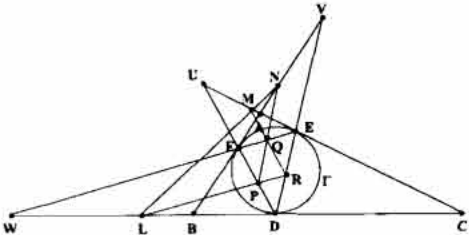
Draw a line through which is parallel to . This passes through the midpoints of and of . Similarly the line through parallel to passes through the mid-point of and of ; the line through parallel to passes through the mid-point of and of . We thus obtain the medial triangle of . Since , the line is also the bisector of . Similarly bisects and bisects .
Thus , , concur at , the in-centre of . Now Desargues' theorem is applicable to the triangles and . It follows that , and are collinear. Thus , and are collinear.
Want a route through all this instead of an archive? The track
puts 2,604 problems in a working order, from Junior Challenge level to the IMO shortlist.