Let be the incenter of triangle . Let be a point on side , and be a point on ray such that lies between and and . Let be the foot of perpendicular from to line . Prove that .
(Proposed by B. Battsengel, G. Batzaya)
Mongolian National Mathematical Olympiad
Solution
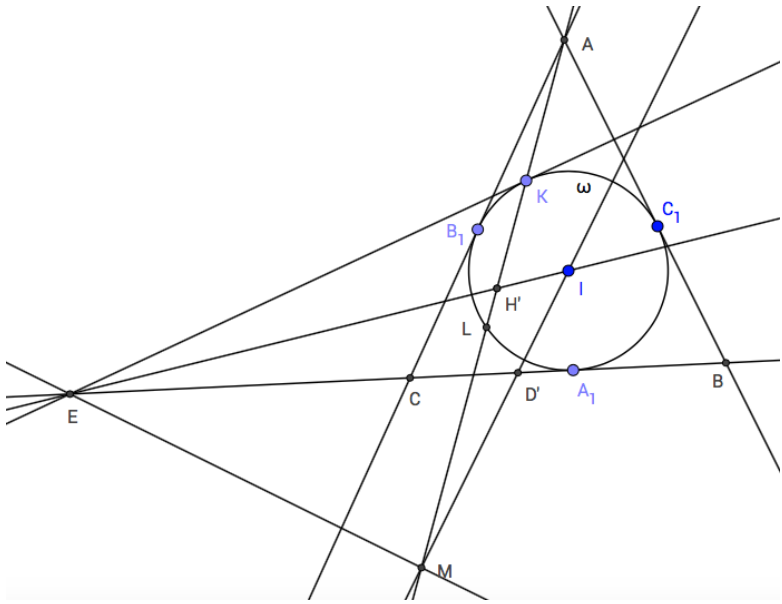
Let be the incircle of the triangle , , , be the touching points of with sides , and respectively. Let be the circle with diameter , and be the intersection point of and , different from . Denote by be the intersection point of and . We claim that and are collinear. For this, it suffices to show that and are harmonic because is uniquely determined by the given ratio, where is the intersection point of and . Since we get and so , i.e, is tangent to the circle . Thus
Clearly, the points are harmonic and the cross-ratio is defined as a ratio of sines. Therefore we can conclude that and are harmonic since , and . Hence , implying the claim.
Let be the intersection point of and . Since the points and lie on a circle. Thus and .
Want a route through all this instead of an archive? The track
puts 2,604 problems in a working order, from Junior Challenge level to the IMO shortlist.