Maths Olympiad Prep

Library / /4 of 5

Geometry Difficulty 4.2 AIME Prove it Croatia

Let AA, BB, CC and DD be points on a circle such that AB=BC=CD|AB| = |BC| = |CD|. The angle bisectors of ABD\angle ABD and ACD\angle ACD intersect at the point EE.
If the lines AEAE and CDCD are parallel, find ABC\angle ABC.
(Matko Ljulj)

Solution

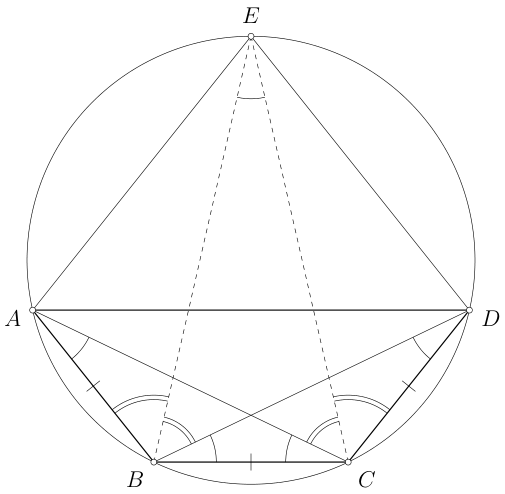
Due to symmetry, the isosceles triangles ABCABC and BCDBCD are congruent, and the cyclic quadrilateral ABCDABCD is an isosceles trapezium.
Figure 1

Let us denote by xx the measure of angles along the bases in ABCABC and BCDBCD. Then ABC=BCD=1802x\angle ABC = \angle BCD = 180^\circ - 2x and ABD=ACD=1803x\angle ABD = \angle ACD = 180^\circ - 3x, from which we get EBC=ECB=90x2\angle EBC = \angle ECB = 90^\circ - \frac{x}{2} and BEC=x\angle BEC = x. Hence, the point EE lies on the same circle as AA, BB, CC and DD.
We also have ADC=ADB+BDC=ACB+BDC=x+x=2x\angle ADC = \angle ADB + \angle BDC = \angle ACB + \angle BDC = x + x = 2x and ECD=12ACD=9032x\angle ECD = \frac{1}{2}\angle ACD = 90^\circ - \frac{3}{2}x.
Since AECDAE \parallel CD, the cyclic quadrilateral ACDEACDE is an isosceles trapezium as well, so ADC=ECD\angle ADC = \angle ECD holds, and we get 7x=1807x = 180^\circ. Therefore, ABC=57180\angle ABC = \frac{5}{7} \cdot 180^\circ.

Want a route through all this instead of an archive? The track puts 2,000 problems in a working order, from AMC 10 level to the IMO shortlist.

Source: MathNet, licensed CC-BY-4.0. Statement and solution reproduced as published; topic and difficulty added by this site.