Let be the foot of the altitude drawn to the hypotenuse of a right triangle . The inradii of the triangles , and are , and , respectively. Prove that .
Estonian Math Competitions
Solutions — 2
Solution 1
Let , , and ; then .
Note that the triangles ABC, ACD and CBD are similar by two equal angles (Fig. 28). As the similarity ratio of triangles ACD and ABC is and that of triangles CBD and ABC is , we have and , whence . As the equality implies , we obtain . On the other hand, the equality implies . Consequently, .
Solution 2
Let the incenters of the triangles ABC, ACD and BCD be I, I_1 and I_2. Let the points of tangency of the incircle of the triangle ABC with sides BC, CA and AB be K, L and M, respectively; let the points of tangency of the incircle of the triangle ACD with sides DC, CA and AD be K_1, L_1 and M_1, respectively; let the points of tangency of the incircle of the triangle BCD with sides DC, CB and BD be K_2, L_2 and M_2, respectively (Fig. 29). As a tangent line is perpendicular to the radius drawn to the point of tangency, we have . Thus IKCL is a square by three right angles and the equality . Hence . Similarly we see that
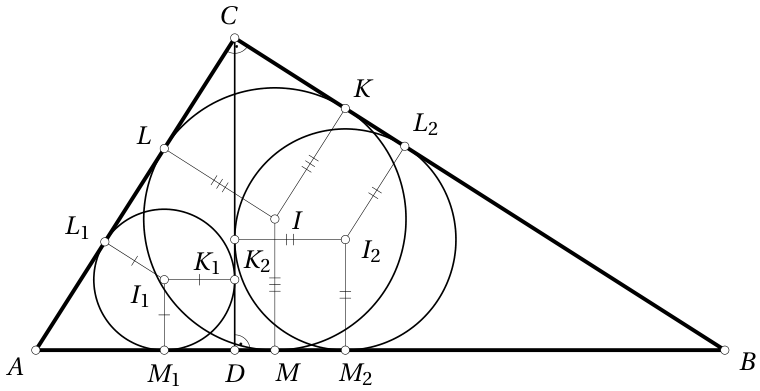
and are squares, whereby and . By property of tangent line segments, we have , and , whence
By symmetry, we also get . After adding up these two equalities and taking into account that , we obtain
Consequently, .
Want a route through all this instead of an archive? The track
puts 2,604 problems in a working order, from Junior Challenge level to the IMO shortlist.