Let be a cyclic quadrilateral. Assume that the points , , , are collinear in this order, in such a way that the line is tangent to the circle , and the line is tangent to the circle . Let and be the midpoints of and , respectively. Prove that the following three lines are concurrent: line , the tangent of circle at point , and the tangent to circle at point .
International Mathematical Olympiad
Solutions — 2
Solution 1
We first prove that triangles and are similar. Since is cyclic, we have . By the tangency of to the circle we also have . The claimed similarity is proven.
Let be the midpoint of . Points and correspond in the proven similarity, and so .
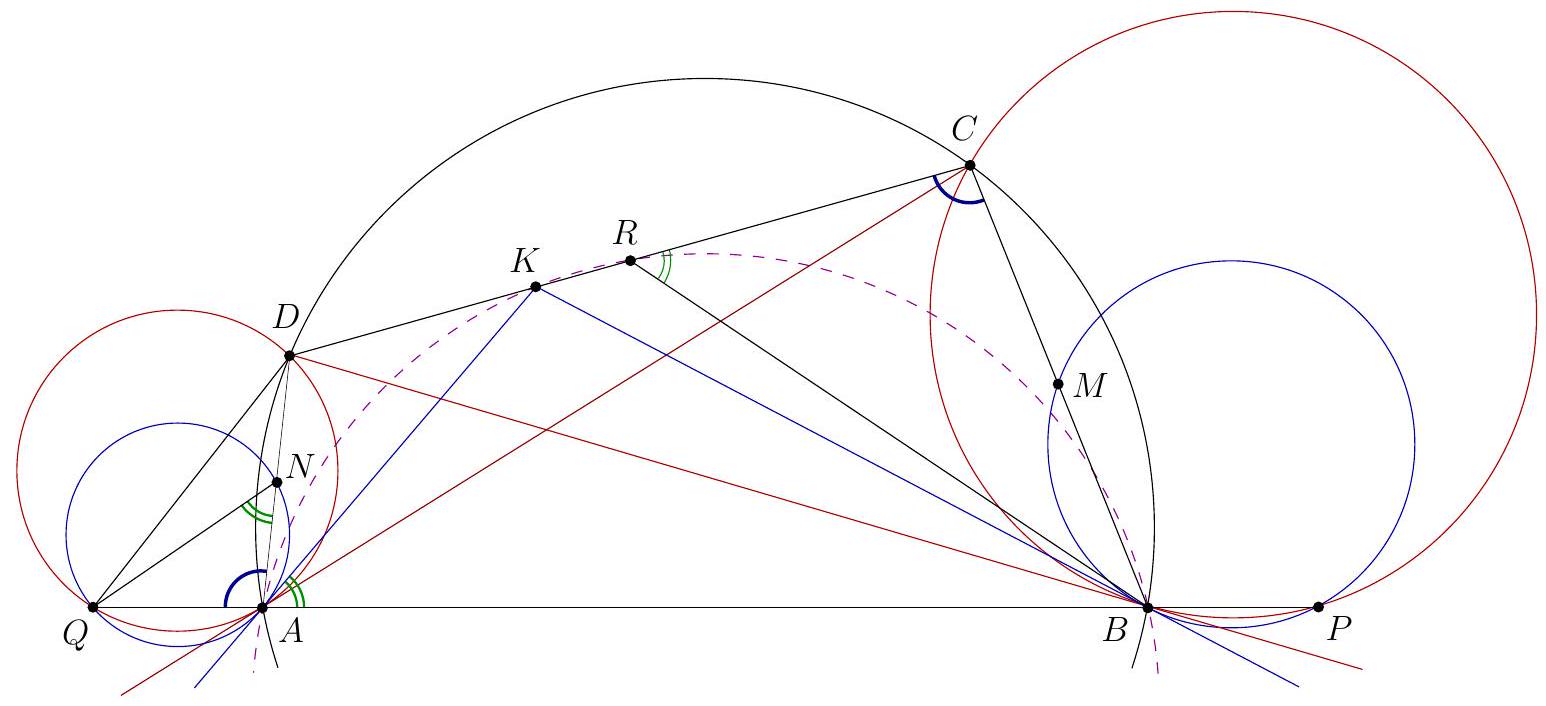
Let be the second common point of line with circle (i.e., if intersects circle , then is the other intersection; otherwise, if is tangent to , then ). In both cases, we have ; that indicates that is tangent to circle . It can be showed analogously that is tangent to circle .
Solution 2
We present a second solution, without using the condition that is cyclic. Again, and can be any points on lines and such that .
Let and meet at (if then is their common ideal point). Let meet the tangent to the circle at , and the tangent to the circle at at points and , respectively.
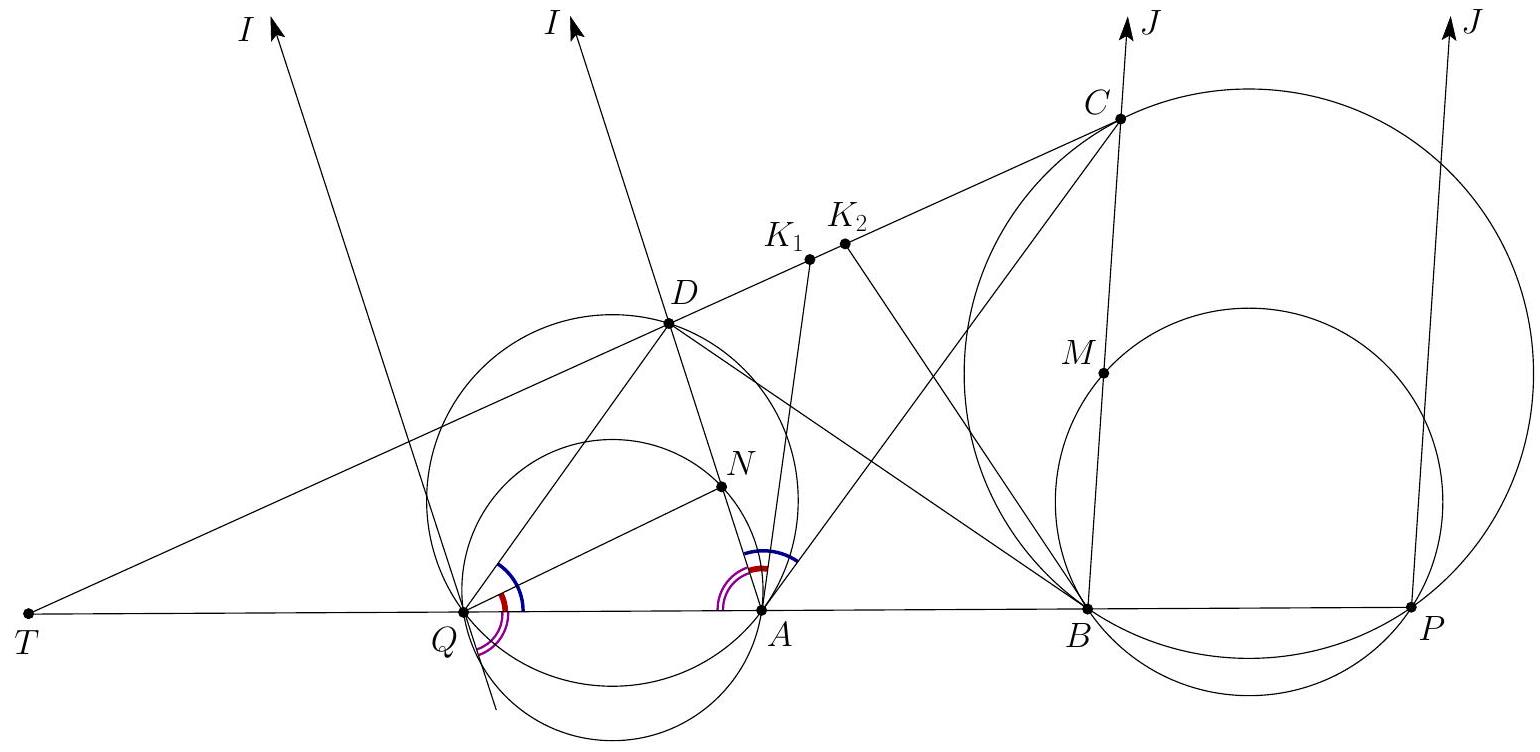
Let and be the ideal points of and , respectively. Notice that the pencils (, , , ) and (, , , ) of lines are congruent, because , and . Hence,
It can be obtained analogously that
From we get and hence .
Want a route through all this instead of an archive? The track
puts 2,604 problems in a working order, from Junior Challenge level to the IMO shortlist.