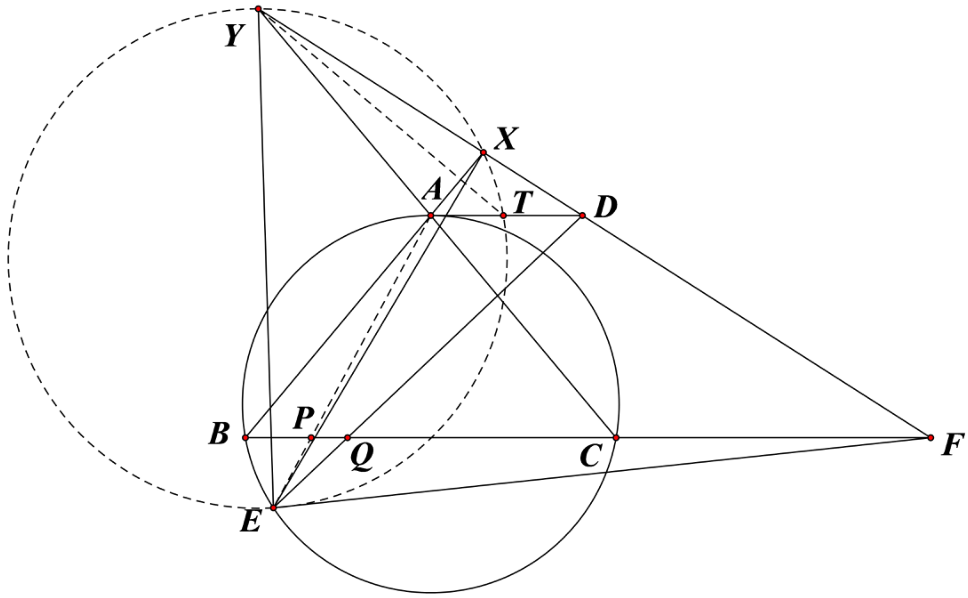
Given an isosceles triangle ABC with AB=AC. Let a moving point D satisfy AD∥BC and DB>DC. Let a moving point E be on the arc BC of the circumcircle of △ABC that does not contain A, such that EB<EC. Let F be a point on the extension of BC such that ∠DFE=∠ADE. The extension of FD intersects the extension of BA at point X, and the extension of FD intersects the extension of CA at point Y. Prove that ∠XEY is constant.
Solution
Proof 1. Let AE and DE intersect line BC at points P and Q, respectively. Since AB=AC and A, B, E, C are concyclic, we have ∠ABP=∠ACB=∠AEB. Hence, AP⋅AE=AB2.
Note that Q might be on the extension of BC, but F can only be on the extension of BQ. Otherwise, if F is on the ray QB, combining with F being on the extension of BC would lead to ∠DFE>∠DCE>∠FCE>90∘, while clearly ∠ADE<90∘, which contradicts ∠ADE=∠DFE.
Since AD∥BC, we have ∠DQF=∠ADE=∠DFE, thus DQ⋅DE=DF2. Therefore, DF2AB2=DQ⋅DEAP⋅AE=DE2AE2, implying DFAB=DEAE. Hence DXAX=DFAB=DEAE. Similarly, DYAY=DFAC=DEAE.
Take a point T on segment AD such that TDAT=DEAE. Then X, Y, E, and T are concyclic (Apollonian circle). Notice that XT and YT bisect ∠AXD and ∠ATD, respectively. Therefore, ∠XEY=∠XTY=∠TXD−∠TYD=21∠AXD−21∠AYD=21∠XAY=21∠BAC is a fixed value. □
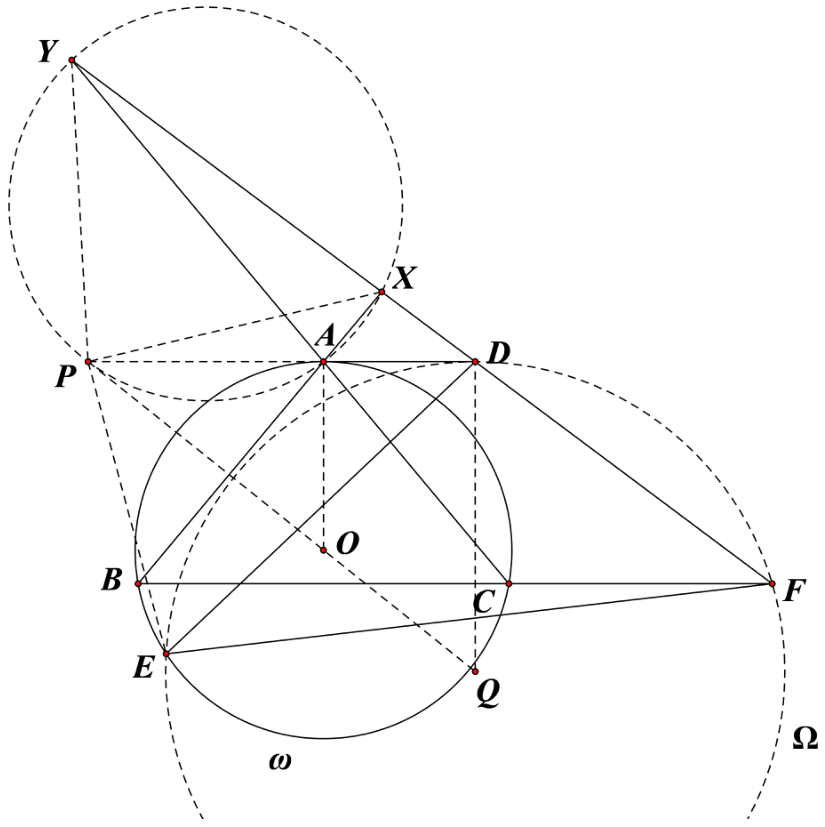
Proof 2. Since AB=AC and AD∥BC, AD bisects the external angle ∠XAY. Let P be the intersection of the perpendicular bisector of XY and AD. It is known that A, X, Y, and P are concyclic. Hence, ∠PYD=∠PXY=∠PAY, thus △PYD∼△PAY. This implies PA⋅PD=PY2 and PDPA=(YDYA)2.
Let ω be the circumcircle of △ABC with center O, and Ω be the circumcircle of △DEF with center Q. Clearly, PA is tangent to ω at point A, and since ∠DFE=∠ADE, PA is also tangent to Ω at point D. Since AD∥CF, we have DQAO=sin∠DEFDFsin∠ABCAC=DFAC⋅sin∠DAYsin∠YDA=(YDYA)2=PDPA. Thus, P is the external homothety center of circles ω and Ω.
Since E is the intersection of ω and Ω, it is known that PE2=PA⋅PD. In fact, let E′ be the image of E under the homothety centered at P with ratio PDPA. Then AE∥DE′, implying ∠PEA=∠PE′D=∠PDE. Thus, PE2=PA⋅PD.
Therefore, PE=PA⋅PD=PY=PX. Hence, P is the circumcenter of △EXY. Therefore, ∠XEY=21∠XPY=21∠XAY=21∠BAC is a fixed value. □
Want a route through all this instead of an archive? The track
puts 2,604 problems in a working order, from Junior Challenge level to the IMO shortlist.
Source: MathNet,
licensed CC-BY-4.0.
Statement reproduced verbatim; metadata (topic, difficulty) added by this project.