Maths Olympiad Prep

Library / /113 of 133

Algebra Difficulty 6.7 National olympiad Prove it Saudi Arabia

Let S={(a,b)a,b=1,2,3,4S=\{(a, b) \mid a, b=1,2,3,4, and ab}a \neq b\}, and consider all nonzero polynomials p(X,Y)p(X, Y) with integer coefficients such that p(a,b)=0p(a, b)=0 for every element (a,b)(a, b) in SS.
(a) What is the minimal degree of such polynomial p(X,Y)p(X, Y)?
(b) Determine all such polynomials p(X,Y)p(X, Y) with minimal degree.

Solution

(a) Let p(X,Y)p(X, Y) be such a polynomial. There are two possible cases:

Case 1. If p(1,Y)=p(2,Y)=p(3,Y)=p(4,Y)=0p(1, Y)=p(2, Y)=p(3, Y)=p(4, Y)=0. In this case
(X1)(X2)(X3)(X4) (X-1)(X-2)(X-3)(X-4)
is a factor of p(X,Y)p(X, Y) and therefore degp(X,Y)4\deg p(X, Y) \geq 4.

Case 2. If there exists a0{1,2,3,4}a_{0} \in \{1,2,3,4\} such that p(a0,Y)0p\left(a_{0}, Y\right) \neq 0. Because p(a0,b)=0p\left(a_{0}, b\right)=0 for b{1,2,3,4}{a0}b \in \{1,2,3,4\} \setminus \{a_{0}\}, the nonzero polynomial p(a0,Y)p\left(a_{0}, Y\right) has 3 different roots and therefore degp(X,Y)degp(a0,Y)3\deg p(X, Y) \geq \deg p\left(a_{0}, Y\right) \geq 3.

Hence degp(X,Y)3\deg p(X, Y) \geq 3.

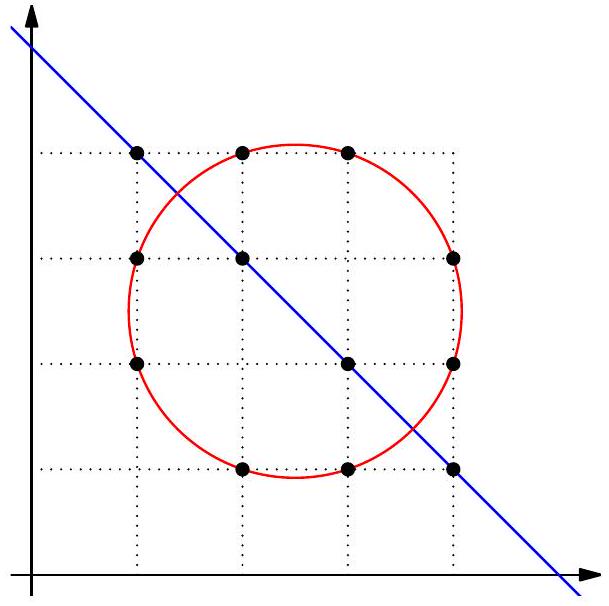
To construct such a polynomial of degree 3, consider, as shown in the figure, the line of equation x+y5=0x+y-5=0 and the circle of equation (x52)2+(y52)252=0\left(x-\frac{5}{2}\right)^{2}+\left(y-\frac{5}{2}\right)^{2}-\frac{5}{2}=0.

Figure 1

The graph obtained by union of this line and this circle passes by all the points of SS. Therefore, the polynomial
p0(X,Y)=(X+Y5)(X2+Y25X5Y+10) p_{0}(X, Y)=(X+Y-5)\left(X^{2}+Y^{2}-5 X-5 Y+10\right)
satisfies the condition p0(a,b)=0p_{0}(a, b)=0 for all (a,b)S(a, b) \in S and is of degree 3. Hence the minimal degree of such polynomials p(X,Y)p(X, Y) is 3.

(b) Let p(X,Y)p(X, Y) be a nonzero polynomial of degree 3 with integer coefficients such that p(a,b)=0p(a, b)=0 for every element (a,b)(a, b) in SS. From (a), there exists a0{1,2,3,4}a_{0} \in \{1,2,3,4\} such that p(a0,Y)0p\left(a_{0}, Y\right) \neq 0. Let p0(X,Y)=(X+Y5)((2X5)2+(2Y5)210)p_{0}(X, Y)=(X+Y-5)\left((2 X-5)^{2}+(2 Y-5)^{2}-10\right) and define the polynomial
q(X,Y)=p0(a0,a0)p(X,Y)p(a0,a0)p0(X,Y). q(X, Y)=p_{0}\left(a_{0}, a_{0}\right) p(X, Y)-p\left(a_{0}, a_{0}\right) p_{0}(X, Y).
Polynomial q(X,Y)q(X, Y) is of degree at most 3. But polynomial q(a0,Y)q\left(a_{0}, Y\right) has at least 1,2,3,41,2,3,4 as roots. Therefore q(a0,Y)=0q\left(a_{0}, Y\right)=0, which means that q(X,Y)=(Xa0)q1(X,Y)q(X, Y)=\left(X-a_{0}\right) q_{1}(X, Y) for some polynomial q1(X,Y)q_{1}(X, Y) of degree at most 2. But for any a{1,2,3,4}{a0},q1(a,Y)a \in \{1,2,3,4\} \setminus \{a_{0}\}, q_{1}(a, Y) has at least 3 roots, which implies that q1(a,Y)=0q_{1}(a, Y)=0. Hence (X1)(X2)(X3)(X4)(X-1)(X-2)(X-3)(X-4) divides q(X,Y)q(X, Y) of degree 3. Therefore q(X,Y)=0q(X, Y)=0. Because p0(X,Y)p_{0}(X, Y) is a unitary polynomial, we deduce that
p(X,Y)=kp0(X,Y), for some kZ. p(X, Y)=k p_{0}(X, Y), \quad \text{ for some } k \in \mathbb{Z}.

Want a route through all this instead of an archive? The track puts 2,000 problems in a working order, from AMC 10 level to the IMO shortlist.

Source: MathNet, licensed CC-BY-4.0. Statement and solution reproduced as published; topic and difficulty added by this site.