Maths Olympiad Prep

Library / /17 of 39

Geometry Difficulty 5.4 AIME, harder Prove it Ukraine

Consider the acute ABC\triangle ABC and point DD on the side ABAB. Let's denote the center of the circumscribed circle around the ACD\triangle ACD as PP and the center of the circumscribed circle around the BDC\triangle BDC as QQ. Prove that triangles ABCABC and DPQDPQ are similar.

(Bogdan Rublyov)

Solution

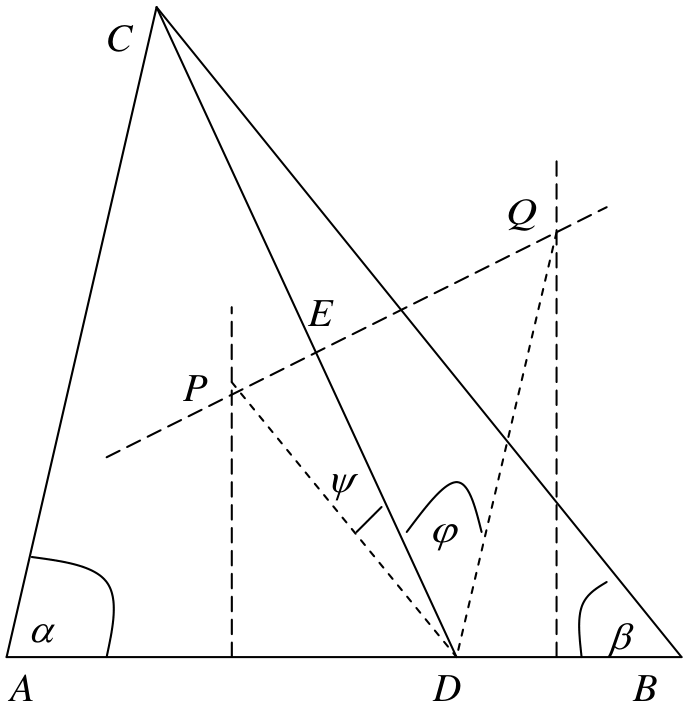
Let's denote the radius of the circumscribed circle around the ACD\triangle ACD as R1R_1, the radius of the circumscribed circle around the BDC\triangle BDC as R2R_2. So, if CD=lCD = l then by the law of sines (Fig.47):
lsinβ=2R1sinβ=l2R1. \frac{l}{\sin \beta} = 2R_1 \Rightarrow \sin \beta = \frac{l}{2R_1}.
Herewith, cosφ=DEDQ=l2R1=sinβ\cos \varphi = \frac{DE}{DQ} = \frac{l}{2R_1} = \sin \beta.
Therefore, from the acute triangle ABC\triangle ABC φ=π2β\varphi = \frac{\pi}{2} - \beta, and similarly ψ=π2α\psi = \frac{\pi}{2} - \alpha.
Therefore PDQ=φ+ψ=π2α+π2β=παβ=γ=ACB\angle PDQ = \varphi + \psi = \frac{\pi}{2} - \alpha + \frac{\pi}{2} - \beta = \pi - \alpha - \beta = \gamma = \angle ACB.

Figure 1
Fig. 47

Moreover, from the following equation:
QDPD=R1R2=l2sinβ2sinαl=sinαsinβ=ab=CBAC \frac{QD}{PD} = \frac{R_1}{R_2} = \frac{l}{2\sin\beta} \cdot \frac{2\sin\alpha}{l} = \frac{\sin\alpha}{\sin\beta} = \frac{a}{b} = \frac{CB}{AC}

the sides about the equal angles of our triangles are proportional, so triangles ABCABC and DPQDPQ are similar for any point DABD \in AB. Points A,BA, B do not satisfy the condition, otherwise one of the ACD\triangle ACD or BDC\triangle BDC degenerates to a line segment.

Want a route through all this instead of an archive? The track puts 2,000 problems in a working order, from AMC 10 level to the IMO shortlist.

Source: MathNet, licensed CC-BY-4.0. Statement and solution reproduced as published; topic and difficulty added by this site.