Maths Olympiad Prep

Library / /77 of 106

Geometry Difficulty 8.7 Shortlist Prove it China

Consider five points AA, BB, CC, DD and EE such that ABCDABCD is a parallelogram and BCEDBCED is a cyclic quadrilateral. Let ll be a line passing through AA. Suppose that ll intersects the interior of the segment DCDC at FF and intersects line BCBC at GG. Suppose also that EF=EG=ECEF = EG = EC. Prove that ll is the bisector of DAB\angle DAB.

Solution

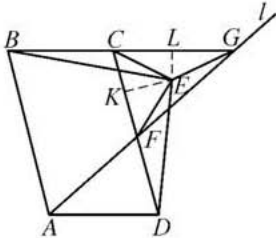
Draw the altitudes of two isosceles triangles EGCEGC and ECFECF as in the figure.
In view of the given condition, it is easy to see that ADFGCF\triangle ADF \sim \triangle GCF. Hence
Figure 1

ADGC=DFCFBCCG=DFCFBCCL=DFCKBC+CLCL=DF+FKCKBLCL=DKCKBLDK=CLCK. \begin{aligned} \frac{AD}{GC} &= \frac{DF}{CF} \Rightarrow \frac{BC}{CG} = \frac{DF}{CF} \Rightarrow \frac{BC}{CL} = \frac{DF}{CK} \\ &\Rightarrow \frac{BC + CL}{CL} = \frac{DF + FK}{CK} \\ &\Rightarrow \frac{BL}{CL} = \frac{DK}{CK} \\ &\Rightarrow \frac{BL}{DK} = \frac{CL}{CK}. \end{aligned} \quad ①

Since BCEDBCED is a cyclic quadrilateral, LBE=EDK\angle LBE = \angle EDK, this yields BLEDKE\triangle BLE \sim \triangle DKE, where both are right-angled triangles.
SoBLDK=ELEK. \text{So} \qquad \frac{BL}{DK} = \frac{EL}{EK}. \qquad ②

In view of ① and ②, CLCK=ELEK\frac{CL}{CK} = \frac{EL}{EK}, this means CLECKE\triangle CLE \sim \triangle CKE.
Thus
CLCK=CECE=1, \frac{CL}{CK} = \frac{CE}{CE} = 1,
i.e. CL=CKCG=CFCL = CK \Rightarrow CG = CF.
It is intuitively obvious that BAG=GAD\angle BAG = \angle GAD. Hence ll is the bisector.

Want a route through all this instead of an archive? The track puts 2,000 problems in a working order, from AMC 10 level to the IMO shortlist.

Source: MathNet, licensed CC-BY-4.0. Statement and solution reproduced as published; topic and difficulty added by this site.