The four vertices of quadrilateral lie on the circle with diameter . The diagonals of intersect at , and the lines and intersect at . Line meets at and line meets the circle again at . Prove that is perpendicular to .
IRL ABooklet
Solutions — 3
Solution 1
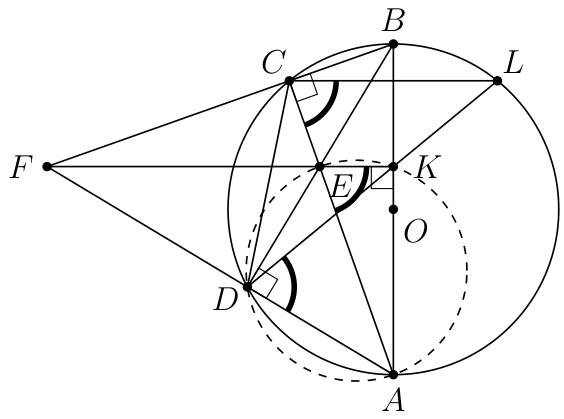
Note that (angles in a semicircle). It follows that is the orthocentre of . Therefore is perpendicular to . It follows that is cyclic. Therefore . Since (same segment), we have which implies that is parallel to . Since is perpendicular to , this implies that is perpendicular to .
Solution 2
Because the angles and are right angles, is the orthocentre of triangle and is perpendicular to . From the right angles and we see that is cyclic, hence . Because was given to be cyclic, we have . The right angled triangles and are similar as they share an angle at , and so . Together, this implies
and this means that is the angle bisector of .
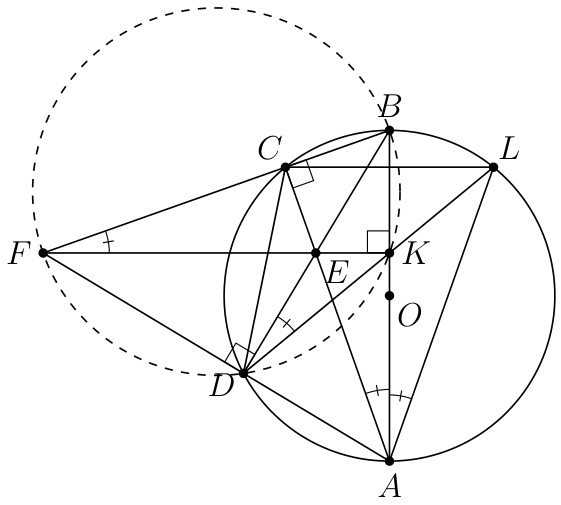
As a consequence, the right angled triangles ALB and ACB are congruent, which shows that triangle LAC is isosceles with |AL| = |AC|. It is a well known fact about isosceles triangles, which easily follows from ASA, that the angle bisector AB is perpendicular to the opposite side CL.
Solution 3
It is known that the altitudes of a triangle are the internal angle bisectors of its orthic triangle. Armed with this knowledge we proceed as follows.
Because the angles and are right angles, is the orthocentre of triangle and is perpendicular to . Hence, is the orthic triangle of triangle , which implies that is the angle bisector of .
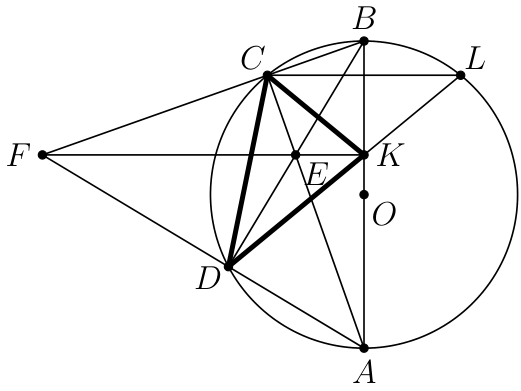
Now we use the fact that an angle bisector in a triangle meets the perpendicular bisector of the opposite side on the circumcircle of that triangle. Applying this to triangle LDC we see that B is the point on the circumcircle where the angle bisector of meets the perpendicular bisector of CL, which passes through the circumcentre O of triangle LDC. Hence, BO is perpendicular to CL.
Want a route through all this instead of an archive? The track
puts 2,604 problems in a working order, from Junior Challenge level to the IMO shortlist.