Given an acute triangle () and let be its circumcircle. The excircle corresponding to the vertex , of center , tangents to the side at the point and to the extensions of the sides , at the points , respectively. Let and be the intersection points of the circles and , the orthocenter of the triangle and the midpoint of segment . The parallel line through the point to the line meets the line at the point . Prove that the perpendicular line through the point to the line and the parallel line through the point to the line meet each other on the line .
BMO, 2017
Solution
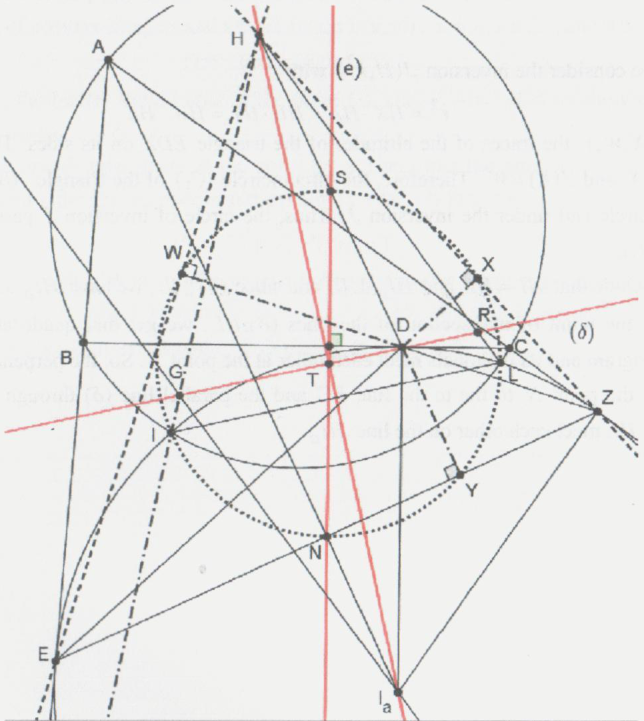
We have and , so . Let , be the midpoints of the segments , respectively and the point of intersection of the lines , . Then, , and .
The Euler circle of the triangle passes through the points , , . Therefore, the segment is a diameter of the circle . Thus, the center of , let , is the midpoint of the segment .
On the other hand, we know that the center of Euler circle is the midpoint of . So . Therefore, the line passes through the points , .
Therefore, we get that the quadrilateral is parallelogram and its diagonals meet each other at the point .
We consider the inversion . As we have . Similarly, if , the midpoints of the segments , respectively, we get, and .
Therefore, the circumcircle of the triangle is the image of the circle under the inversion and the points of the intersection of the circles and are invariant under this inversion. But it is well known that the circle of inversion passes through the points of the intersection of the circles and . Thus, the Euler circle passes through the points , .
Also, we consider the inversion with
where , , the traces of the altitudes of the triangle on its sides. Then, , and . Therefore, the circumcircle of the triangle is the image of the circle under the inversion . Thus, the circle of inversion passes through the points , .
We conclude that and and since , we have .
If is the point of intersection of the lines , , we get that quadrilateral is parallelogram and its diagonals meet each other at the point . So, the perpendicular line through the point to the line and the parallel line through the point to the line , meet each other on the line .
Want a route through all this instead of an archive? The track
puts 2,604 problems in a working order, from Junior Challenge level to the IMO shortlist.