There are given 12 red points on a circle. Find the minimum of , such that there exist triangles, whose vertices are red points, satisfying every chord with red endpoints being a side of one triangle. (Posed by Tao Pingsheng)
China Southeastern Mathematical Olympiad
Solution
Let the set of 12 red points be . From , one can get 11 chords with red points, but every triangle with vertex has two such chords, and so the 11 chords should be in at least 6 triangles with being an endpoint. The same applies to (); we need
triangles, and every triangle has 3 points. So .
On the other hand, the following example shows that can be 24.
Consider a circle whose perimeter is 12, and the 12 red points are on the circle with equal distance.
The number of chords with red endpoint is . If the length of the minor arc to a chord is , then say “the chord belongs to .” So we have only six kinds of chords, and the number of chords belonging to 1, 2, ..., 5 is 12, and that belonging to 6 is 6.
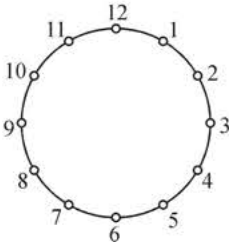
If three chords belonging to () can be the sides of a triangle, then or . So the triangles .
Now we give an example:
The number of (1, 2, 3) triangles is 6, whose vertices are
.
The number of (1, 5, 6) triangles is 6, whose vertices are
.
The number of (2, 3, 5) triangles is 6, whose vertices are
.
The number of (4, 4, 4) triangles is 3, whose vertices are
.
The number of (2, 4, 6) triangles is 3, whose vertices are
.
So the minimum is 24.
Want a route through all this instead of an archive? The track
puts 2,604 problems in a working order, from Junior Challenge level to the IMO shortlist.